Question
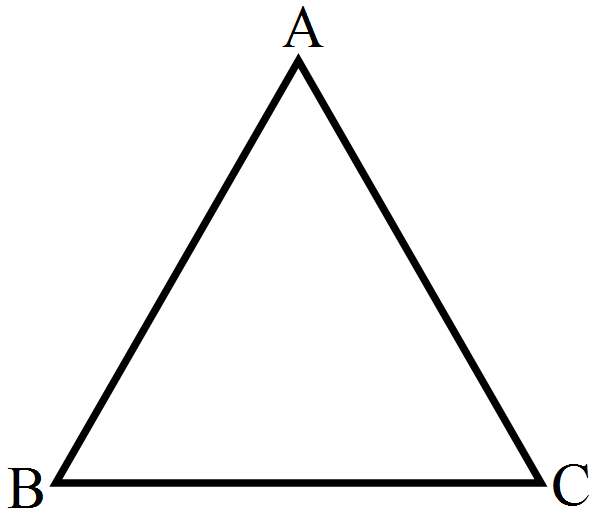
Angles A, B, C of a triangle ABC are equal to each other. Prove that $\triangle\text{ABC}$ is equilateral.

Answer

Given that angles A, B, C of a triangle ABC equal to each other.

We have to prove that $\triangle\text{ABC}$ is equilateral
We have, $\angle\text{A}=\angle\text{B}=\angle\text{C}$
Now,
$\angle\text{A}=\angle\text{B}$
BC = AC [opposite sides to equal angles are equal]
And $\angle\text{B}=\angle\text{C}$
$\text{AC}=\text{AB}$
From the above we get
$\text{AB}=\text{BC}=\text{AC}$
$\triangle\text{ABC}$ is equilateral.

Need a full question paper?

Generate a complete, print-ready paper with questions like this in minutes — across 16+ boards, with answer keys.
Start Generating Free

Similar questions

Prove that two different circles cannot intersect each other at more than two points.
The perimeter of an isosceles triangle is 32cm. The ratio of the equal side to its base is 3 : 2. Find the area of the triangle.
Multiply$ x^2 + 4y^2 + z^2 + 2xy + xz - 2yz$ by $(-z + x - 2y).$
P, Q, R and S are respectively the mid-points of sides AB, BC, CD and DA of quadrilateral ABCD in which AC = BD and $\text{AC}\bot\text{BD}.$ Prove that PQRS is a square.
Simplify: $(x^2 + y^2 - z^2)^2 - (x^2 - y^2 + z^2)^2$
The number of books in different shelves of a library is as follows:
30, 32, 28, 24, 20, 25, 38, 37, 40, 45, 16, 20
19, 24, 27, 30, 32, 34, 35, 42, 27, 28, 19, 34
38, 39, 42, 29, 24, 27, 22, 29, 31, 19, 27, 25
28, 23, 24, 32, 34, 18, 27, 25, 37, 31, 24, 23
43, 32, 28, 31, 24, 23, 26, 36, 32, 29, 28, 21
Prepare a cumulative frequency distribution table using 45 - 49 as the last class-interval.
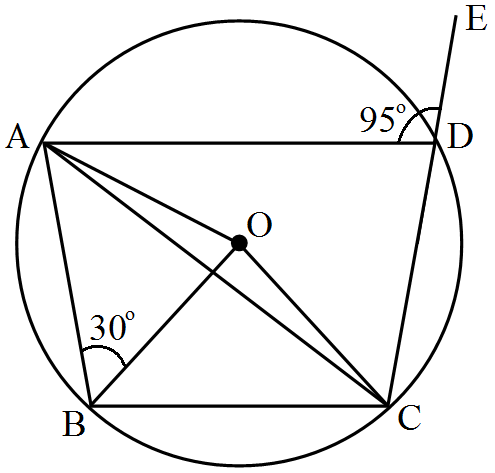
In the given figure, ABCD is a quadrilateral inscribed in a circle with centre O. CD is produced to E such that $\angle\text{AED} = 95^\circ$ and $\angle\text{OBA} = 30^\circ$ Find $\angle\text{OAC.}$
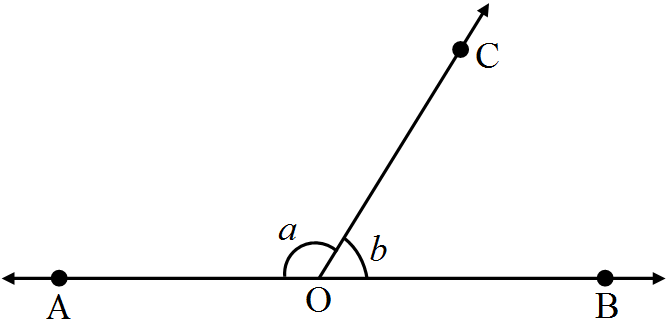
In figure, $\angle\text{AOC}$ and $\angle\text{BOC}$ from a linear pair. If a - 2b = 30°, find a and b.
The height of a conical vessel is 3.5cm. If its capacity is 3.3 litres of milk. Find its diameter of its base.
If the side BC of $\triangle\text{ABC}$ is produced on both sides, then write the difference between the sum of the exterior angles so formed and $\angle\text{A}.$