Question
Angular displacement $(\theta )$ of a flywheel varies with time as $\theta  = at + b{t^2} + c{t^3}$ then angular acceleration is given by  

Answer

(d)   Angular acceleration $\alpha  = \frac{{{d^2}\theta }}{{d{t^2}}} = \frac{{{d^2}}}{{d{t^2}}}(at + b{t^2} + c{t^3})$$ = 2b + 6ct$

Need a full question paper?

Generate a complete, print-ready paper with questions like this in minutes — across 16+ boards, with answer keys.
Start Generating Free

Similar questions

Which one of the following statements is true
A mass of $2 \,kg$ is whirled in a horizontal circle by means of a string at an initial speed of $5$ revolutions per minute. Keeping the radius constant the tension in the string is doubled. The new speed is nearly ....... $rpm$
In the Young's double slit experiment, the intensities at two points  $P_1$  and  $P_2$  on the screen are respectively $I_1$  and $I_2$ . If $P_1$  is located at the centre of a bright fringe and $P_2$  is located at a distance equal to a quarter of fringe width from $P_1$  then $\frac {I_1}{I_2}$ is
$A$ particle of mass m is constrained to move on $x$ -axis. $A$ force $F$ acts on the particle. $F$ always points toward the position labeled $E$. For example, when the particle is to the left of $E, F$ points to the right. The magnitude of $F$ is a constant $F$ except at point $E$ where it is zero. The system is horizontal. $F$ is the net force acting on the particle. The particle is displaced a distance $A$ towards left from the equilibrium position $E$ and released from rest at $t = 0.$ Velocity - time graph of the particle is
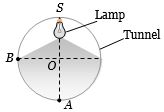
An electric lamp is fixed at the ceiling of a circular tunnel as shown is figure. What is the ratio the intensities of light at base A and a point B on the wall
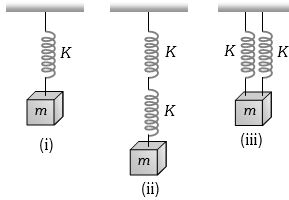
Five identical springs are used in the following three configurations. The time periods of vertical oscillations in configurations (i), (ii) and (iii) are in the ratio
A body travels uniformly a distance of $ (13.8 \pm 0.2) m$ in a time $(4.0 \pm 0.3)\, s$. The velocity of the body within error limits is
Two balls are thrown horizontally from the top of a tower with velocities $v_1$ and $v_2$ in opposite directions at the same time. After how much time the angle between velocities of balls becomes $90^o$ ?
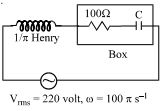
In the circuit, as shown in the figure, if the value of $R.M.S$ current is $2.2$ ampere, the power factor of the box is 
The temperature at which a black body of unit area loses its energy at the rate of $1$ joule/second is