MCQ
Answer the following by appropriately matching the lists based on the information given in the paragraph.

In a thermodynamics process on an ideal monatomic gas, the infinitesimal heat absorbed by the gas is given by $T \Delta X$, where $T$ is temperature of the system and $\Delta X$ is the infinitesimal change in a thermodynamic quantity $X$ of the system. For a mole of monatomic ideal gas

$X=\frac{3}{2} R \ln \left(\frac{T}{T_A}\right)+R \ln \left(\frac{V}{V_A}\right)$. Here, $R$ is gas constant, $V$ is volume of gas, $T_A$ and $V_A$ are constants.

The $List-I$ below gives some quantities involved in a process and $List-II$ gives some possible values of these quantities.

List-$I$ List-$II$
$(I)$ Work done by the system in process $1 \rightarrow 2 \rightarrow 3$ $(P)$ $\frac{1}{3} R T_0 \ln 2$
$(II)$ Change in internal energy in process $1 \rightarrow 2 \rightarrow 3$ $(Q)$ $\frac{1}{3} RT _0$
$(III)$ Heat absorbed by the system in process $1 \rightarrow 2 \rightarrow 3$ $(R)$ $R T _0$
$(IV)$ Heat absorbed by the system in process $1 \rightarrow 2$ $(S)$ $\frac{4}{3} RT _0$
  $(T)$ $\frac{1}{3} RT _0(3+\ln 2)$
  $(U)$ $\frac{5}{6} RT _0$

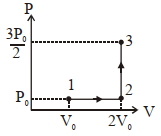
If the process carried out on one mole of monatomic ideal gas is as shown in figure in the PV-diagram with $P _0 V _0=\frac{1}{3} RT _0$, the correct match is,

$(1)$$I \rightarrow Q, II \rightarrow R , III \rightarrow P , IV \rightarrow U$

$(2)$ $I \rightarrow S , II \rightarrow R , III \rightarrow Q , IV \rightarrow T$

$(3)$ $I \rightarrow Q , II \rightarrow R , III \rightarrow S , IV \rightarrow U$

$(4)$ $I \rightarrow Q , II \rightarrow S , III \rightarrow R , IV \rightarrow U$

($2$) If the process on one mole of monatomic ideal gas is an shown is as shown in the $TV$-diagram with $P _0 V _0=\frac{1}{3} RT _0$, the correct match is

$(1)$ $I \rightarrow S, II \rightarrow T, III \rightarrow Q , IV \rightarrow U$

$(2)$ $I \rightarrow P , II \rightarrow R, III \rightarrow T , IV \rightarrow S$

$(3)$ $I \rightarrow P, II \rightarrow, III \rightarrow Q, IV \rightarrow T$

$(4)$ $I \rightarrow P, II \rightarrow R, III \rightarrow T, IV \rightarrow P$

Give the answer or quetion $(1)$ and $(2)$
  • $3,4$
  • B
    $2,4$
  • C
    $1,4$
  • D
    $2,3$

Answer

Correct option: A.
$3,4$
a
$(I)$ Degree of freedom $f=3$

Work done in any proces $5$ Area under P-V graph $\Rightarrow$ Work dooe in $1 \rightarrow 2 \rightarrow 3= P _1 V$,

$=\frac{ RI _0}{3} \Rightarrow(Q)$

$(II)$ Change in intemal energy $1 \rightarrow 2 \rightarrow 3$

$\Delta U =\Delta C \Delta T$

$=\frac{f}{2} n R A T$

$=\frac{f}{2}\left(P_t V_t-P_2 V_i\right)$

$=\frac{3}{2}\left(\frac{3 P_0}{2} 2 V _4- P _0 V _0\right)$

$=3 P _0 V _0$

$\Delta U = RT _{ b } \Rightarrow( R )$

$(III)$ Heat absorbed in $1 \rightarrow 2 \rightarrow 3$

for any process, $I^4$ law of thermodymmics

$\Delta Q =\Delta W +\infty$

$\Delta Q = RT _4+\frac{R T_3}{3}$

$\Delta Q =\frac{4 RT }{3} \Rightarrow( s )$

$(IV)$ Heat absorbed in process $1 \rightarrow 2$

$\Delta Q=\Delta U+W$

$=\frac{f}{2}\left(P_t V_f-P_V V_0\right)+W$

$=\frac{3}{2}\left(P_a 2 V_0-P_0 V_0\right)+P_a V_0$

$=\frac{5}{2} P_0 V_a$

$=\frac{5}{2}\left(\frac{R I_0}{3}\right)$

$\Delta Q-\frac{5 R I_0}{6} \Rightarrow(U)$

($2$) Process $1 \rightarrow 2$ is isothermal (temmerature constaut)

Process $2 \rightarrow 3$ is isochoric (volme constant)

$(I)$ Work done in $1 \rightarrow 2 \rightarrow 3$

$W = W _{1 \rightarrow 2}+ W _{2 \rightarrow 1}$

$=n R T \ln \left(\frac{V_t}{V_i}\right)+ W _{2 \rightarrow 1}$

$=\frac{R I_0}{3} \ln \left(\frac{2 V_4}{V_0}\right)+0$

$W =\frac{R T_1}{3} \ln 2 \Rightarrow \text { (P) }$

$\text { (II) } \Delta U \text { in } 1 \rightarrow 2 \rightarrow 3$

$\Delta U=\frac{f}{2} n R\left(T_4-T_i\right)$

$=\frac{3}{2} R\left( T _0-\frac{T_4}{5}\right)$

$=\frac{3}{2} R\left(\frac{2 T_0}{3}\right)$

$\Delta U=R_0 \quad(R)$

$(III)$ For any system first law of thermodynamics for $1 \rightarrow 2 \rightarrow 3$

$\Delta Q=\Delta U+W$

$\Delta Q=R T_0+\frac{R T_1}{3} \ln 2$

$\Delta Q=\frac{R I_0}{3}(3+\ln 2) \Rightarrow \text { (T) }$

$(IV)$ For process $1 \rightarrow 2$ (isothermal)

$\Delta Q =\Delta U + W$

$=\frac{ f }{2} RR \left( I _e- T _{ i }\right)+ RRT \ln \left( V _e / V _{ i }\right)$

$=0+ R \left(\frac{ T _{ e }}{3}\right) \ln \left(\frac{2 v _{ e }}{ V _{ a }}\right)$

$\Delta Q =\frac{R T_4}{3} \ln 2 \Rightarrow( P )$

Need a full question paper?

Generate a complete, print-ready paper with questions like this in minutes — across 16+ boards, with answer keys.

Start Generating Free

Similar questions

Which of the following in the measure of inertia:
Relation between the colour and the temperature of a star is given by
The dimension of quantity $\frac{L}{RCV}$ is
Frequency range of the audible sounds is
Which of the following curve represents the correctly distribution of elongation $(y)$ along heavy rod under its own weight $L \rightarrow$ length of rod, $x \rightarrow$ distance of point from lower end?
A railway line is taken round a circular arc of radius $1000\ m$ , and is banked by raising the outer rail $h$ $m$ above the inner rail. If the lateral force on the inner rail when a train travels round the curve at $10\ ms^{-1}$ is equal to the lateral force on the outer rail when the train's speed is $20\ ms^{-1}$ . The value of $4g\ tan\theta $ is equal to : (The distance between the rails is $1.5\ m$ )
A block starts from rest at the top of frictionless slide at a height, $h_1$ above the ground. The block leaves the slide moving perfectly horizontally at a height $h_2$ above the ground. The block eventually hits the ground travelling at an angle $\theta = 30^o$ below the horizontal. Then
A ball of mass $1 \;kg$ is thrown vertically upwards and returns to the ground after $3\; seconds$. Another ball, thrown at $60^{\circ}$ with vertical also stays in air for the same time before it touches the ground. The ratio of the two heights are
There have been suggestions that the value of the gravitational constant $G$ becomes smaller when considered over very large time period $($in billions of years$)$ in the future. If that happens, for our earth,
The driver of a car travelling with speed $30 \,\,m/s$ towards a hill sounds a horn of frequency $600\,\, Hz.$ If the velocity of sound in air is $330 \,\,m/s$, the frequency of reflected sound as heard by driver is .... $Hz$