Question
Answer the following question:
Every metal has a definite work function. Why do all photoelectrons not come out with the same energy if incident radiation is monochromatic? Why is there an energy distribution of photoelectrons?
Answer

Work function indicates the minimum energy required for the electron in the highest level of the conduction band to get out of the metal.
Not all electrons in the metal belong to this level but, rather they occupy a continuous band of levels. Consequently, for the same incident radiation, electrons knocked off from different levels come out with different energies.

Need a full question paper?

Generate a complete, print-ready paper with questions like this in minutes — across 16+ boards, with answer keys.

Start Generating Free

Similar questions

The magnetic properties of the different materials A, B and C are shown in the following table:
Material Permeability Susceptibility Temperature dependence of susceptibility.
A Low positive Small but negative Independent of temperature
B High Very high 1 Susceptibility decreases with temperature
C Greater than 1 Small but positive Decreases with temperature
Which of the above three materials should be used for making an electromagnet and why?
A capacitor of capacitance 'C' is being charged by connecting it across a dc source along with an ammeter.Will the ammeter show a momentary deflection during the process of charging? If so, how would you explain this momentary deflection and the resulting continuity of current in the circuit? Write the expression for the current inside the capacitor.
Can virtual image be formed on the retina in a seeing process?
Find the dimensions of:
  1. The specific heat capacity c.
  2. The coefficient of linear expansion a.
  3. The gas constant R.
Some of the equations involving these quantities are$\text{Q = mc(T}_2-\text{T}_1),\text{l}_{\text{t}}=\text{l}_0[1+\alpha(\text{T}_2-\text{T}_1)]$ and $\text{PV = nRT}.$
A hydrogen atom contains one proton and one electron. It may be assumed that the electron revolves in a circle of radius 0.53 angstrom (1 angstrom $= 10^{-10}m$ and is abbreviated as A) with the proton at the centre. The hydrogen atom is said to be in the ground state in this case. Find the magnitude of the electric force between the proton and the electron of a hydrogen atom in its ground state.
What information would you wish to know about the galvanometer before converting it into an ammeter or voltmeter?
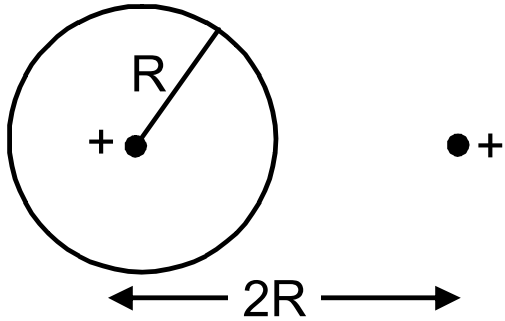
Find the flux of the electric field through a spherical surface of radius R due to a charge of $10^{-7}$ C at the centre and another equal charge at a point 2R away from the centre.
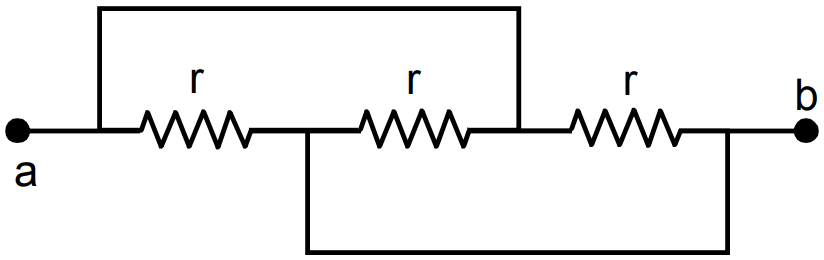
Find the equivalent resistance of the network shown in figure. between the points a and b.
If the total mechanical energy of a particle is zero, is its linear momentum necessarily zero? Is it necessarily non-zero?
The speed of the yellow light in a certain liquid is $2.4 \times 10^8 \mathrm{~m} / \mathrm{s}$. Find the refractive index of the liquid.