Question
Answer the following question:
Two students are separated by a 7 m partition wall in a room 10 m high. If both light and sound waves can bend around obstacles, how is it that the students are unable to see each other even though they can converse easily.
Answer

The size of the obstacle or aperture should be comparable to the wavelength for diffraction of waves by obstacles, through a large angle.
This follows from $\text{sin}\theta=\frac{\lambda}{\text{a}}.$
For light waves,
Wavelength, $\lambda=10^{-7} \text{m and},$
Size of the wall, a = 10 m
$\therefore\ \text{sin}\theta=\frac{10^{-7}}{10}=10^{-8}$
This implies, $\theta\ \rightarrow\ 0$
That is, light goes almost unbent and hence, the students are unable to see each other.
For sound waves,
Frequency, $\nu$ = 1000 Hz
$\text{i.e}\ \frac{\text{c}}{\nu}=\frac{330}{1000}=0.33\ \text{m}$
$\therefore\ \text{sin}\theta=\frac{\lambda}{\text{a}}=\frac{0.33}{10}=0.033\ \text{m}$
Here, $\theta$ has a definite value and the waves will bend around the partition. Hence, students can converse easily.

Need a full question paper?

Generate a complete, print-ready paper with questions like this in minutes — across 16+ boards, with answer keys.

Start Generating Free

Similar questions

The total energy of an electron in the first excited state of the hydrogen atom is about –3.4 eV.
  1. What is the kinetic energy of the electron in this state?
  2. What is the potential energy of the electron in this state?
  3. Which of the answers above would change if the choice of the zero of potential energy is changed?
Answer the following question:
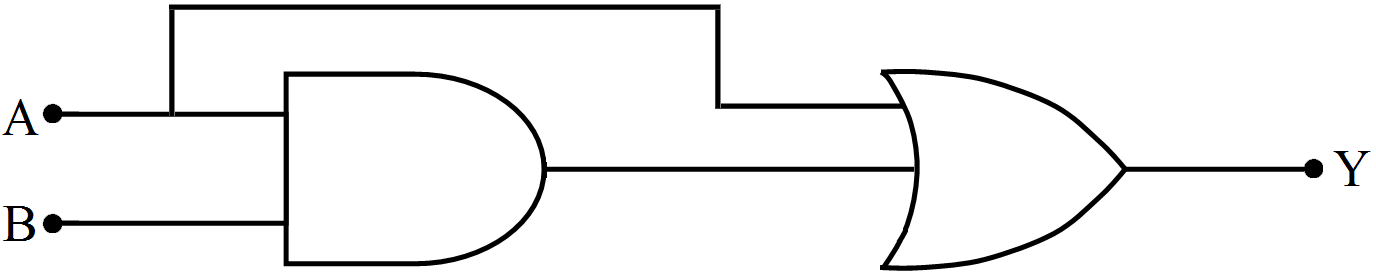
  1. Write the truth table of the following gate.
  1. What will be the values of inputs A and B for the Boolean expression.
$\text{A}\bar{+}\text{B}).(\text{A}\bar{.}\text{B})=1$
In Young’s double slit experiment, the two slits are separated by a distance of $1·5 \ mm$ and the screen is placed $1 m$ away from the plane of the slits. A beam of light consisting of two wavelengths $650 \ nm$ and $520 \ nm$ is used to obtain interference fringes. Find.
  1. The distance of the third bright fringe for $\lambda = 520$ nm on the screen from the central maximum.
  2. The least distance from the central maximum where the bright fringes due to both the wavelengths coincide.
State Gauss's theorem in electrostatics. Apply this theorem to derive an expression for electric field intensity at a point near an infinitely long straight charged wire.
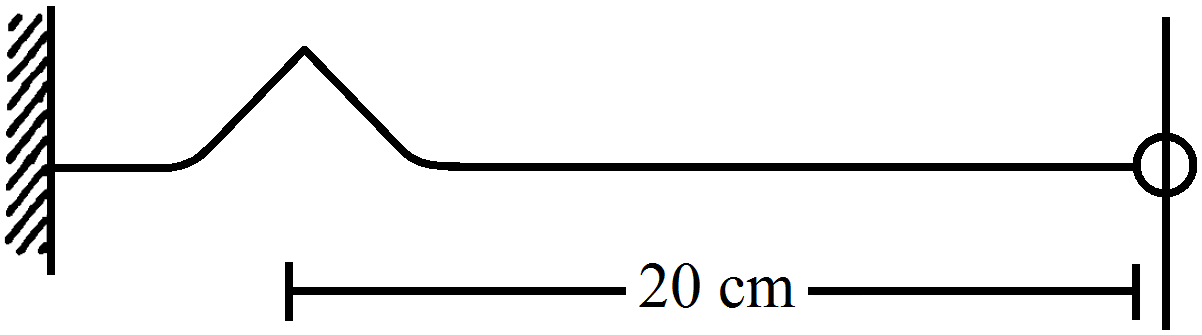
A string of linear mass density 0.5g/cm and a total length 30cm is tied to a fixed wall at one end and to a frictionless ring at the other end figure, The ring can move on a vertical rod. A wave pulse is produced on the string which moves towards the ring at a speed of 20cm/s. The pulse is symmetric about its maximum which is located at a distance of 20cm from the end joined to the ring.
  1. Assuming that the wave is reflected from the ends without loss of energy, find the time taken by the string to regain its shape.
  2. The shape of the string changes periodically with time. Find this time period.
  3. What is the tension in the string?
With what considerations in view, a photodiode is fabricated? State its working with the help of a suitable diagram.
Eventhough the current in the forward bias is known to be more than in the reverse bias, yet the photodiode works in reverse bias. What is the reason?
Two identically charged particles are fastened to the two ends of a spring of spring constant $100Nm^{-1}$ and natural length $10\ cm.$ The system rests on a smooth horizontal table. If the charge on each particle is $2.0 \times 10^{-8}C$, find the extension in the length of the spring. Assume that the extension is small as compared to the natural length. Justify this assumption after you solve the problem.
A heater coil is cut in two parts and only one of them is used in the heater. What is the ratio of the heat produced by this half coil to that by the original coil if the voltage applied is the same?
A $p-n$ photodiode is fabricated from a semiconductor with band gap of $2.8\ eV$. Can it detect a wavelength of $6000\ nm$?
Why are the magnification properties of microscopes and telescopes defined in terms of the ratio of angles and not in terms of the ratio of sizes of objects and images?