Question
Answer the following questions:
  1. Define electric flux. Write its $SI $ unit.
  2. Using Gauss’s law, prove that the electric field at a point due to a uniformly charged infinite plane sheet is independent of the distance from it.
  3. How is the field directed if:
  • The sheet is positively charged.
  • Negatively charged?

Answer

  1. Electric flux: It is defined as the total number of electric field lines passing through an area normal to its surface.
$\Phi=\oint\vec{\text{E}}.\vec{\text{dS}}$
The $SI$ unit is $Nm^2/ C$ or volt $-$ metre.
  1. Image
Let electric charge be uniformly distributed over the surface of a thin, non-conducting infinite sheet.
Let the surface charge density $($i.e., charge per unit surface area$)$ be $\sigma$ .
​​​​​​​We need to calculate the electric field strength at any point distant r from the sheet of charge.
To calculate the electric field strength near the sheet, we now consider a cylindrical Gaussian surface bounded by two plane faces $A$ and $B$ lying on the opposite sides and parallel to the charged sheet and the cylindrical surface perpendicular to the sheet$ ($fig$)$. By symmetry the electric field strength at every point on the flat surface is the same and its direction is normal outwards at the points on the two plane surfaces and parallel to the curved surface.
Total electric flux,
or $\oint\limits_\text{S}\vec{\text{E}}.\vec{\text{dS}}=\oint\limits_{\text{S}_1}\vec{\text{E}}.\vec{\text{dS}_1}+\oint\limits_{\text{S}_2}\vec{\text{E}}.\vec{\text{dS}_2}+\oint\limits_{\text{S}_3}\vec{\text{E}}.\vec{\text{dS}_3}$
$\oint\limits_\text{S}\vec{\text{E}}.\vec{\text{dS}}=\oint\limits_{\text{S}_1}\text{E dS}_1\cos0^\circ+\oint\limits_{\text{S}_2}\text{E dS}_2\cos0^\circ+\oint\limits_{\text{S}_3}\text{E dS}_3\cos90^\circ$
$=\text{E}\oint\text{dS}_1+\text{E}\oint\text{dS}_2=\text{Ea}+\text{Ea}=2\text{Ea}$
$\therefore$ Total electric flux $= 2Ea$
As $\sigma$ is charge per unit area of sheet and a is the intersecting area, the charge enclosed by Gaussian surface $=\sigma\text{a}$
Total electric flux $=\frac{1}{\epsilon_0}\times  \ ($total charge enclosed by the surface$)$
i.e., $2\text{Ea}=\frac{1}{\epsilon_0}(\sigma\text{a})$
$\therefore\ \text{E}=\frac{\text{p}}{2\epsilon_0}.$
Thus electric field strength due to an infinite flat sheet of charge is independent of the distance of the point.
  1.  
  • If $\sigma$ is positive, $\vec{\text{E}}$ points normally outwards/ away from the sheet.
  • If $\sigma$ is negative, $\vec{\text{E}}$ points normally inwards/ towards the sheet.

Need a full question paper?

Generate a complete, print-ready paper with questions like this in minutes — across 16+ boards, with answer keys.

Start Generating Free

Similar questions

Obtain an expression for motional electromotive force.
The terminology of different parts of the electromagnetic spectrum is given in the text. Use the formula E = hv (for energy of a quantum of radiation : photon) and obtain the photon energy in units of eV for different parts of the electromagnetic spectrum. In what way are the different scales of photon energies that you obtain related to the sources of electromagnetic radiation?
Write the definition of electric capacitance. A parallel plate capacitor is filled with a medium of dielectric constant K between the plates. Find the expression of its capacitance. Draw the necessary diagram.
The ${\text{K}_\beta}\  X-$rays from certain elements are given below. Draw a Moseley$-$type plot of $\sqrt{\text{v}}$ versus $Z$ for $\text{K}_\beta$ radiation.
Element
$Ne$ $P$ $Ca$ $Mn$ $Zn$ $Br$
Energy $(keV)$
$0.858$ $2.14$ $4.02$ $6.51$ $9.57$ $13.3$
Consider the situation of the previous problem. Suppose each of the blocks is pulled by a constant force $F$ instead of any impulse. Find the maximum elongation that the spring will suffer and the distances moved by the two blocks in the process.
Two charges $q_1$ and $q_2$ are placed at $(0, 0, d)$ and $(0, 0, -d)$ respectively. Find locus of points where the potential a zero.
a. State the condition for resonance to occur in series LCR a.c. circuit and derive an expression for resonant frequency.
b. Draw a plot showing the variation of the peak current $\left( i _{ m }\right)$ with frequency of the a.c, source used. Define the quality factor Q of the circuit.
Derive Snell's law for refraction of light by Huygen's wave theory.
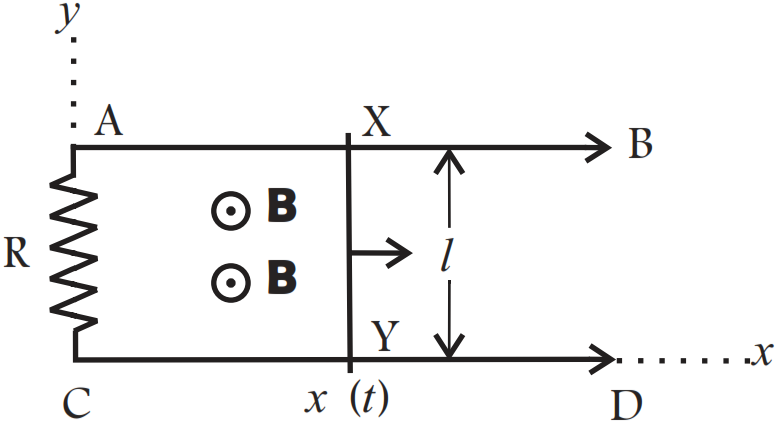
A conducting wire $XY$ of mass m and neglibile resistance slides smoothly on two parallel conducting wires as shown in Fig. The closed circuit has a resistance $R$ due to $AC. AB$ and $CD$ are perfect conductors. There is a magnetic field $\text{B}=\text{B}(\text{t})\hat{\text{k}}$.
  1. Write down equation for the acceleration of the wire $XY.$
  2. If $B$ is independent of time, obtain $v(t),$ assuming $v(0) = u_0.$
  3. For $(b),$ show that the decrease in kinetic energy of $XY$ equals the heat lost in $R$.
An electrical device draws $2kW$ power from $AC$ mains $(\text{voltage }223\text{V}\text{(rms)}=\sqrt{50.000}\text{V})$. The current differs (lags) in phase by $\phi\Big(\tan\phi=\frac{-3}{4}\Big)$ as compared to voltage. Find,
  1. $R,$
  2. $X_C - X_L,$
  3. $I_M$. Another device has twice the values for $R, X_C$ and $X_L$. How are the answers affected?