Question
Answer the following questions:
Explain the changes the primary oocyte undergoes while in different follicular stages before ovulation.

Answer

Changes in the primary oocyte:
  • Each primary oocyte gets surrounded by a single layer of granulosa cells and is known as primary follicle.
  • Primary follicle get surrounded by more layers of granulosa cells and a new theca and form secondary follicle.
  • A secondary follicle transforms into tertiary follicle characterised by a fluid-filled space, the antrum.
  • Primary oocyte undergoes first meiotic division and produces two unequal haploid cells-a large haploid secondary oocyte and a tiny first polar body.
  • The tertiary follicle further changes into the mature Graafian follicle.
  • The secondary oocyte forms a new membrane called zona pellucida around it.

Need a full question paper?

Generate a complete, print-ready paper with questions like this in minutes — across 16+ boards, with answer keys.

Start Generating Free

Similar questions

  1. Give reasons for:
  1. Both strands of DNA are not copied during transcription.
  2. Transcription and translation in bacteria can be coupled.
  1. Differentiate between the process of transcription in prokaryotes and eukaryotes.
Who gave theory of use and disuse of organs? Discuss in detail the inheritance acquired character?
How does replication of the long DNA molecule occur? Explain the process.

OR

Explain the process of DNA replication with the help of a replicating fork.
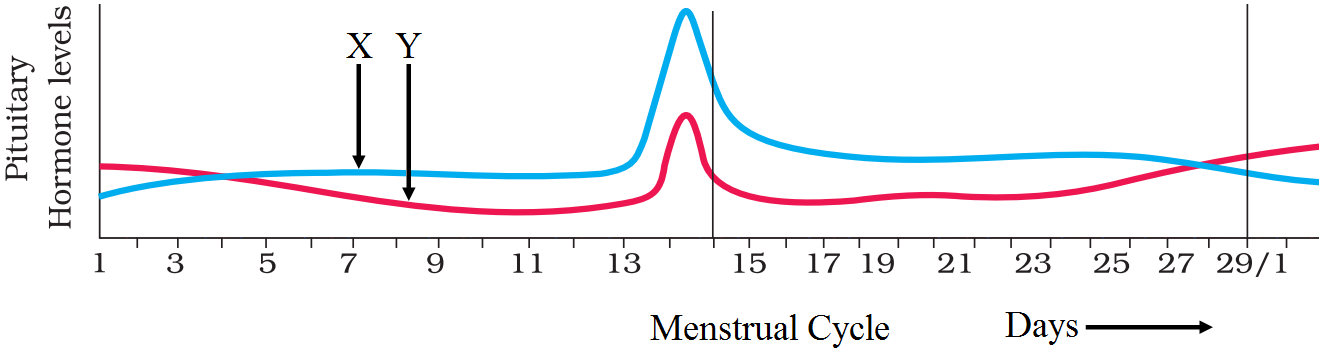
Study the graph given below and answer the questions that follow:

Name the hormones ‘X’ and ‘Y’.

State the laws of inheritance that can be derived from such a cross.
A pea plant bearing axial flowers is crossed with a pea plant bearing terminal flowers. The cross is carried out to find the genotype of the pea plant bearing axial flowers. Work out the cross to show the conclusions you arrive at.
About 8% of human male population suffers from colourblindness whereas only about 0.4% of human female population suffers from this disease. Write an explanation to show how it is possible.
(a) Write the name of primates existing on earth about 15 million years ago. Write its important characteristics also?
(b) (i) From where did the animals similar to human being meet?
(ii) In which sequence were neanderthal, homohabilis and homo erectus evolved on earth?
(iii) When did modern man evolve on this planet?
For question 1-4, use this key:

Key-

  1. Ecology.
  2. Population.
  3. Community.
  4. Ecosystem.
  1. A community plus its physical environment.
  2. Study of the interactions of organisms with each other and with the physical environment.
  3. All populations that are found in a particular area.
  4. All members of the same species that inhabit a particular area.
  1. How does a chromosomal disorder differ from a Mendelian disorder?
  2. Name any two chromosomal aberration associated disorders.
  3. List the characteristics of the disorders mentioned above that help in their diagnosis.