Question
Answer the following questions:
How did Morgan show the deviation in inheritance pattern in Drosophila with respect to this law?
Answer

Linkage and Recombination:

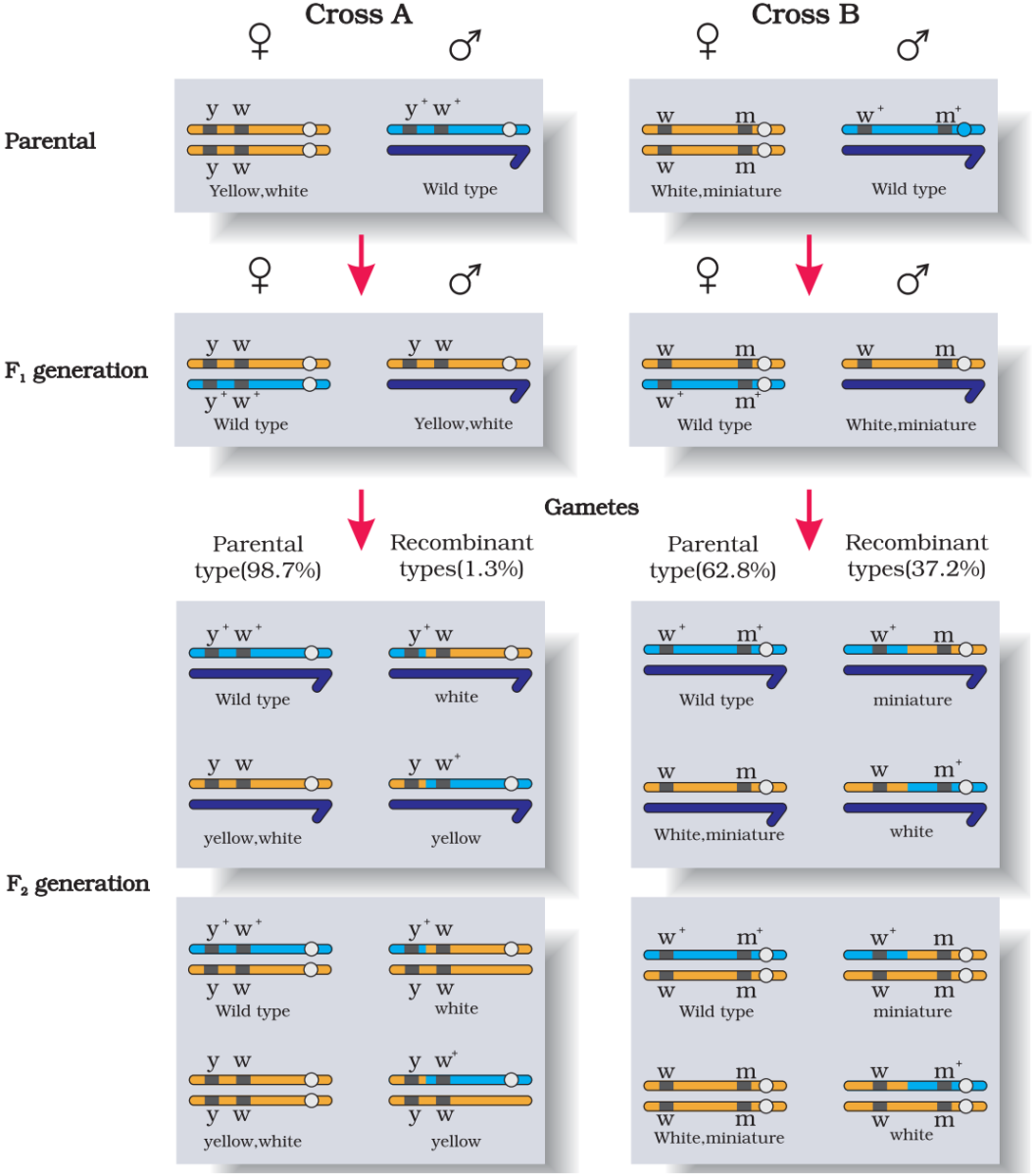
  • T. H. Morgan carried out several dihybrid crosses in Drosophila to study the genes that are sex–linked. He observed that when the two genes in a dihybrid cross are located on the same chromosome, the proportion of parental gene combinations in the progeny was much higher than the non-parental or recombination of genes.
  • Morgan and his group found that when genes are grouped on the same chromosome, some genes are tightly linked or associated and show little recombination.

  • Linkage: Results of two dihybrid crosses conducted by Morgan. Cross A shows crossing between genes y and w; Cross B shows crossing between genes w and m. Here dominant wild type alleles are represented with (+) sign in superscript.
  • When the genes are loosely linked they show higher percentage of recombination.
  • Morgan hybridised yellow bodied and white eyed females with brown bodied and red eyed males (wild type) (cross–A) and inter–crossed their F1 progeny.
  • Alfred Sturtevant determined that genes of Drosophila are arranged in a linear order. He measured the distance between genes and prepared chromosome maps with the position of genes on the chromosomes based on percentage of recombinants. These are also called genetic maps.

Need a full question paper?

Generate a complete, print-ready paper with questions like this in minutes — across 16+ boards, with answer keys.

Start Generating Free

Similar questions

Draw a picture of viral replication. Write the full name of AIDS pathogen. How does hybridization occur? Explain the symptoms of AIDS in human body.
  1. With labelled diagrams, depict stages in embryo development in a dicotyledonous plant.
  2. Endosperm development precedes embryo development. Why?
Explain the process of transcription in a prokaryote.

OR

 Describe the process of transcription in a bacterium.

State the similarity and differences between geitonogamy and xenogamy. Why do cleistogamous flowers assure seed sets?
Briefly mention the contribution of T.H. Morgan in genetics.
a. Draw a diagram of a fully developed embryo sac of an angiosperm. Label its chalazal end and any other five parts within the embryo sac.
b. Why does the development of an endosperm precede that of the embryo in angiosperm?
c. Number of chromosomes in an onion plant cell is 16. Name the cells of the embryo sac having 16 and 24 chromosomes formed after fertilisation.
  1. State the law of independent assortment.
  2. Using Punnett Square demonstrate the law of independent assortment in a dihybrid cross involving two heterozygous parents.
a. Describe aminoacylation of tRNA.
b. Explain the process that takes place in the ribosomes when mRNA makes its entry into it in a prokaryote.
c. Due to transcription error, ATG codon of DNA is transcribed into UAG in mRNA which translates a nonfunctional polypeptide chain in the ribosome. Justify the statement.
Bioreactors are the containment vehicles of any biotechnology-based production process. For large scale production and for economic reasons the final success of biotechnological process depends on the efficiency of the bioreactor.
Answer the following questions w.r.t. the given paragraph:
i. List the operational guidelines that must be adhered to so as to achieve optimisation of the bioreactor system. Enlist any four.
ii. Mention the phase of the growth we refer to in the statement Optimisation of growth and metabolic activity of the cells.
iii. Is the biological product formed in the bioreactor suitable for the intended use immediate? Give reason in support of your answer.
i. Describe the arrangement of nuclei and cells in a mature embryo sac of a typical angiosperm.
ii. Explain the devices the flowering plants have developed to prevent the following types of pollination:
1. Prevents both autogamy and geitonogamy
2. Prevents autogamy, but not geitonogamy