Question
Answer the following questions:
Write balanced equations to represent what happens when.
  1. Cu2+ is treated with KI.
  2. Acidified potassium dichromate solution is reacted with iron (II) solution. (ionic equation).
Answer

  1. $2\text{Cu}^{2+}4\text{I}^-\xrightarrow{\ \ \ \ \ \ \ \ }2\text{Cr}^{3+}+7\text{H}_2\text{O}$

$\text{Cr}_2\text{O}^{2-}_7+14\text{H}^++6\text{e}^-\xrightarrow{ \ \ \ \ \ \ \ \ }2\text{Cr}^{3+}+7\text{H}_2\text{O}$

  1. $\text{Fe}^{2+}\xrightarrow{\ \ \ \ \ \ \ \ \ }\text{Fe}^{3+}+\text{e}^-]\times6$

$\text{Cr}_2\text{O}^{2-}_+6\text{Fe}^{2+}+14\text{H}^+\xrightarrow{\ \ \ \ \ \ \ \ \ }2\text{Cr}^{3+}+6\text{Fe}^{3+}+7\text{H}_2+\text{O}$

Need a full question paper?

Generate a complete, print-ready paper with questions like this in minutes — across 16+ boards, with answer keys.

Start Generating Free

Similar questions

  1. Name the three major classes of carbohydrates and give an example of each of these classes.
  2. Answer the following:
  1. What type of linkage is responsible for the primary structure of proteins?
  2. Name the location where protein synthesis occurs in our bod.
Answer the following questions:
Give chemical reactions for the following observations:
  1. Potassium permanganate is a good oxidising agent in basic medium.
  2. Inter convertibility of chromate ion and dichromate ion in aqueous solution depends upon pH of the solution.
  3. Potassium permanganate is thermally unstable at 513K.
  1. The elements of 3d transition series are given as:

Sc Ti V Cr Mn Fe Co Ni Cu Zn

Answer the following:

  1. Which element has the highest m.p. and why?
  2. Which element is a strong oxidising agent in +3 oxidation state and why?
  3. Which element is soft and why?
  1. Write the equations involved in the preparation of Potassium dichromate from Sodium chromate (Na2CrO4).
Explain the following :
(i) Fermentation
(ii) Dehydration
(iii) Hydrogen bonding in alcohols.
  1. Complete the following chemical equations:
  1. $\text{Cr}_{2}\text{O}_{7}^{2-}\text{(aq)}+\text{H}_{2}\text{S}\text{(g)}+\text{H}^{+}\text{(aq)}\rightarrow$
  2. $\text{Cu}^{2+}\text{(aq)}+\text{I}^{-}\text{(aq)}\rightarrow$
  1. How would you account for the following:
  1. The oxidising power of oxoanions are in the order VO+2 < Cr2O2–7 <MnO4.
  2. The third ionisation enthalpy of manganese (Z = 25) is exceptionally high.
  3. Cr2+ is a stronger reducing agent than Fe2+.
Comment on the statement that elements of the first transition series possess many properties different from those of heavier transition elements.
Answer the following question:
0.6mL of acetic acid (CH3COOH), having density 1.06g mL-1, is dissolved in 1 litre of water. The depression in freezing point observed for this strength of acid was 0.0205°C. Calculate the van’t Hoff factor and the dissociation constant of acid.
In the reaction
Q + R → Products
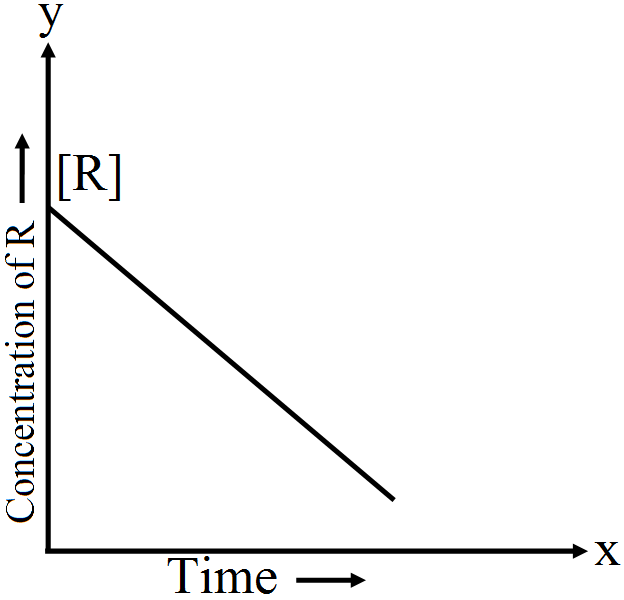
The time taken for 99% reaction of Q is twice the time taken for 90% reaction of R. The concentration of R varies with time as shown in the figure given alongside.

What is the overall order of the reaction? Give the units of the rate constant for the same. Write the rate expression for the above reaction.
(a) Why $\alpha$-hydrogen of carbonyl compound are acidic in nature?
(b) Explain aldol condensation reaction of ethanal.
A voltaic cell is set up at 25°C with the followinng half-cell:
Al | Al3+ (0.001M) and Ni | Ni2+ (0.50M)
Calculate the cell voltage $\text{E}^{\circ}_{\text{Ni}^{2+}/\text{Ni}}\Big[=-0.25\text{V,E}^{\circ}_{\text{Al}^{3+}/\text{Al}}=-1.66\text{V}\Big]$