Question
Answer the following :
There were two fixed points in the original Celsius scale as mentioned above which were  assigned the number 0°C and 100°C respectively. On the absolute scale, one of the fixed points is the triple-point of water, which on the Kelvin absolute scale is assigned the number 273.16 K. What is the other fixed point on this (Kelvin) scale?
Answer

On Kelvin absolute scale the other fixed point is absolute zero temperature (0K).

Need a full question paper?

Generate a complete, print-ready paper with questions like this in minutes — across 16+ boards, with answer keys.

Start Generating Free

Similar questions

Choose the correct alternative:
Acceleration due to gravity is independent of mass of the earth/ mass of the body.
Gravitational force between two bodies at moon surface is _________ gravitational force on earth surface.
In a rotating body, $\text{a}=\alpha\text{r}$ and $\text{v}=\omega\text{r}.$ Thus $\frac{\text{a}}{\alpha}=\frac{\text{v}}{\omega}.$ Can a co you use the theorems of ratio and proportion studied in algebra so as to write
$\frac{\text{a}+\alpha}{\text{a}-\alpha}=\frac{\text{v}+\omega}{\text{v}-\omega}$
You are walking along a seashore and a mild wind is blowing. Is the motion of air a wave motion?
Answer the following :
There were two fixed points in the original Celsius scale as mentioned above which were assigned the number 0°C and 100°C respectively. On the absolute scale, one of the fixed points is the triple-point of water, which on the Kelvin absolute scale is assigned the number 273.16 K. What is the other fixed point on this (Kelvin) scale?
Three vessels have same base area and different neck area. Equal volume of liquid is poured into them, which will possess more pressure at the base?
Water flows at a speed of 6cm/s through a tube of radius 1cm. Coefficient of viscosity of water at room termperature is 0.01 poise. Calculate the Reynolds number. Is it a steady flow?
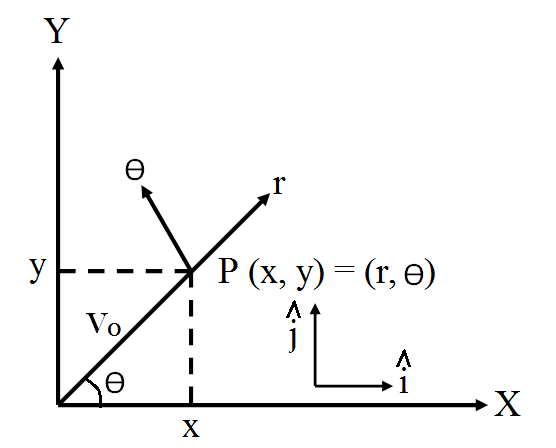
Motion in two dimensions, in a plane can be studied by expressing position, velocity and acceleration as vectors in Cartesian co-ordinates $\text{A}=\text{A}_\text{x}\hat{\text{i}}+\text{A}_\text{y}\hat{\text{j}}$ where $\hat{\text{i}}$ and $\hat{\text{j}}$ are unit vector along x and y directions, respectively and Ax and Ay are corresponding components of A Fig. Motion can also be studied by expressing vectors in circular polar co-ordinates as $\text{A}=\text{A}_\text{r}\hat{\text{r}}+\text{A}_\theta\hat{\theta}$ where $\hat{\text{r}}=\frac{\text{r}}{\text{r}}=\cos\theta\hat{\text{i}}+\sin\theta\hat{\text{j}}$ and $\hat{\theta}=-\sin\theta\hat{\text{i}}+\cos\theta\hat{\text{j}}$ are unit vectors along direction in which ‘r’ and ‘$\theta$’ are increasing.
  1. Express $\hat{\text{i}}$ and $\hat{\text{j}}$ in terms of $\hat{\text{r}}$ and $\hat{\theta}$.
  2. Show that both $\hat{\text{r}}$ and $\hat{\theta}$ are unit vectors and are perpendicular to each other.
  3. Show that $\frac{\text{d}}{\text{dt}}(\hat{\text{r}})=\omega\hat{\theta}$ where $\omega=\frac{\text{d}\theta}{\text{dt}}$ and $\frac{\text{d}}{\text{dt}}(\hat{\text{r}})=-\omega\hat{\text{r}}$
  4. For a particle moving along a spiral given by $\text{r}=\text{a}\theta\hat{\text{r}}$ , where a = 1 (unit), find dimensions of ‘a’.
  5. Find velocity and acceleration in polar vector represention for particle moving along spiral described in (d) above.

What would happen to an artificial satellite, if its orbital velocity is slightly decreased due to some defects in it?
What will be the kinetic energy per molecule per degree of freedom for any gas?