Question
Answer the following:
  1. When does a person need artificial respiration?
  2. From where can the person get supply of oxygen for artificial respiration?
  3. Does the person need to be kept on artificial respiration temporarily or permanently?
Answer

  1. During emergency conditions (e.g. fatal accidents, lungs failure etc.), lungs do not work properly, artificial respiration is required.
  2. The person gets oxygen though an instrument called ventilator which act as artificial lungs.
  3. The person is kept on artificial respiration temporarily. When a person regains his health and starts breathing naturally, artificial respiration is no longer required.

Need a full question paper?

Generate a complete, print-ready paper with questions like this in minutes — across 16+ boards, with answer keys.

Start Generating Free

Similar questions

Briefly describes the human circulatory system?
How can you calculate the absorption of water by soil?
Anil claims to his friend Sanvi that respiration and breathing are the same process. What question(s) Sanvi ask him to make him understand that he is not correct?
Name one organism who respires anaerobically. How does this organism help in beverage and baking industry?
One winter morning, Priya made a cup of hot tea and placed the metal spoon inside it. She held the cup in her hands to feel warm. After a few minutes, she noticed the metal spoon had become hot. Then, she placed the cup on the table near the window where sunlight was coming in. She felt warm standing in the sunlight even without touching anything. Later, she saw the steam rising from the tea and disappearing into the air.
1. Why did the metal spoon become hot?
2. How did Priya feel warm just by standing in the sunlight?
3. What is the process called when hot steam rises from the tea?
Assume, a person is standing in front of a plane mirror. The distance between the mirror and his image is 6m. If the person moves 2 m towards the plane mirror, what would be the distance between the person and his image?
Blue litmus paper is dipped in a solution. It remains blue. What is the nature of the solution? Explain.
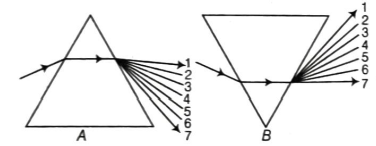
State the correct sequence (1-7) of colours in the spectrum formed by the prisms A and B shown in the figure.
Image

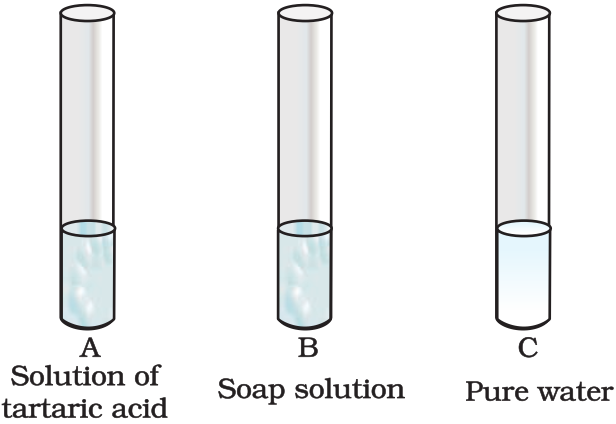
You are provided with three test tubes $A, B$ and $C$ as shown in figure with different liquids. What will you observe when you put:
  1. A piece of blue litmus paper in each test tube?
  2. A piece of red litmus paper in each test tube?
  3. A few drops of phenolphthalein solution to each test tube?
What is the special feature present in a human heart which does not allow mixing of blood when oxygen-rich and carbon dioxide-rich blood reach the heart?