MCQ
Anti-particle of proton is:
- AElectron
- BAntiproton
- CPositron
- DNeutron
Explanation:
antiparticle of proton is antiproton.
Generate a complete, print-ready paper with questions like this in minutes — across 16+ boards, with answer keys.
Molybdenum is used as a target element for production of X-rays because it is
|
(a) A heavy element and can easily absorb high velocity electrons |
| (b) A heavy element with a high melting point |
|
(c) An element having high thermal conductivity |
|
(d) Heavy and can easily deflect electrons |
Hydrogen atoms are excited from ground state of the principal quantum number 4. Then the number of spectral lines observed will be
|
(a) 3 |
(b) 6 |
(c) 5 |
(d) 2 |
Energy conversion in a photoelectric cell takes place from
|
(a) Chemical to electrical |
(b) Magnetic to electrical |
|
(c) Optical to electrical |
(d) Mechanical to electrical |
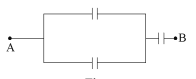
A capacitor of capacity  is charged to the potential of
  . On disconnecting with the battery, it is connected with a capacitor of capacity
  as shown in the adjoining figure. The ratio of energies before and after the connection of switch S will be

|
(a) ( |
(b) |
(c) |
(d) |
If you are provided three resistances 2 W, 3 W and 6 W. How will you connect them so as to obtain the equivalent resistance of 4 W
|
(a)
|
(b)
|
(c)
|
(d) None of these |
What is the coefficient of mutual inductance when the magnetic flux changes by 2  and change in current is 0.01A
|
(a) 2 henry |
(b) 3 henry |
(c) |
(d) Zero |


