MCQ
Any $p-$ orbital can accommodate up to:
  • A
    $4$ electrons
  • B
    $2$ electrons with parallel spins
  • C
    $6$ electrons
  • $2$ electrons with opposite spins

Answer

Correct option: D.
$2$ electrons with opposite spins
d
Any orbital can accommodate a maximum of $2$ electron with opposite spin so $p$ orbital can have $2$ electron with opposite spin.

Need a full question paper?

Generate a complete, print-ready paper with questions like this in minutes — across 16+ boards, with answer keys.
Start Generating Free

Similar questions

Which element has high concentration in plants, as compared to sodium?
Chlorophyll extracted from the crushed green leaves was dissolved in water to make $2\,L$ solution of $Mg$ of concentration $48\,ppm$. The number of atoms of $Mg$ in this solution is $x \times 10^{20}$ atoms. The value of $x$ is (Nearest Integer) (Given : Atomic mass of $Mg$ is $24\,g\,mol ^{-1}$, $N _{ A }=6.02 \times 10^{23}\,mol ^{-1}$ )
Aqueous solution of the following compound on electrolysis gives ethane
During hearing of a court case, the judge suspected that some changes in the documents had been carried out. He asked the forensic department to check the ink used at two different places. According to you which technique can give the best results?
The increasing order of reactivity of the following compounds towards aromatic electrophilic substitution reaction is
Final product of the reaction

 $C{H_3} - CH = C{H_2}\xrightarrow[{CC{l_4}}]{{B{r_2}}}A\xrightarrow[{(3\,\,moles)}]{{\mathop N\limits^ \oplus  a\mathop N\limits^\Theta  {H_2}}}B\xrightarrow{{C{H_3} - Br}}C\xrightarrow[{{H_2}}]{{Pd + BaS{O_4}}}D$
Which of the following does not belong to the same homologous series?
Which of the following benzene ring is most reactive towards electrophile $({E^ \oplus })$ ? 
Complete combustion of $0.858\;g$ of compound $X$ gives $2.63\;g$ of $C{O_2}$ and $1.28\;g$ of ${H_2}O$. The lowest molecular mass $X$ can have ............ $\mathrm{g}$
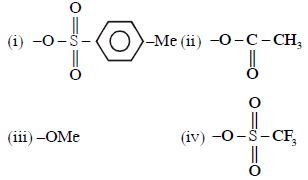
Rank the group in order of decreasing leaving group ability