Question
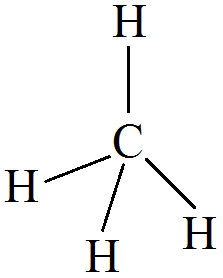
Apart from tetrahedral geometry, another possible geometry for $\mathrm{CH}_4$ is square planar with the four H atoms at the corners of the square and the C atom at its centre. Explain why $\mathrm{CH}_4$ is not square planar?
Answer

Electronic configuration of carbon atom:
${ }_6 \mathrm{C}: 1 \mathrm{~s}^2 2 \mathrm{~s}^2 2 \mathrm{p}^2$
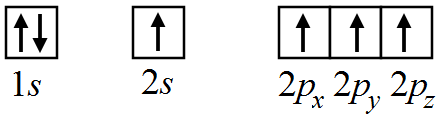
In the excited state, the orbital picture of carbon can be represented as:

Hence, carbon atom undergoes $s p^3$ hybridization in $\mathrm{CH}_4$ molecule and takes a tetrahedral shape.
For a square planar shape, the hybridization of the central atom has to be $d s p^2$. However, an atom of carbon does not have $d$-orbitalsto undergo $d s p^2$ hybridization. Hence, the structure of $\mathrm{CH}_4$ cannot be square planar.
Moreover, with a bond angle of $90^{\circ}$ in square planar, the stability of $\mathrm{CH}_4$ will be very less because of the repulsion existing between the bond pairs. Hence, VSEPR theory also supports a tetrahedral structure for $\mathrm{CH}_4$.

Need a full question paper?

Generate a complete, print-ready paper with questions like this in minutes — across 16+ boards, with answer keys.

Start Generating Free

Similar questions

Explain mechanical work and how is work expressed in different situations? Explain.
S. NO.
Column I
Column II
1.
Li
$Na_2O_2$
2.
Na
$Li_2O$
3.
K
$KO_2$
4.
Rb
$K_2O$
5.
 
$Rb_2O$
Explain the following:
  1. Silicones are used for making water proof fabrics.
  2. Boron does not form $B^{3+}$ ion.
  3. Boric acid is considered as a weak acid.
  4. Carbon forms covalent compounds while lead forms ionic compounds.
  5. Graphite is used as a lubricant.
Explain the molecular orbital diagram of benzene.
What are the major differences between metals and non-metals?
Give the laws for IUPAC nomenclature of organic compounds have multiple groups and give examples.
Calculate the energy required for the process,
$\text{He}^+(\text{g})\rightarrow\text{He}^{2+}\text{(g)}+\text{e}^-$
The ionization energy for the H atom in the ground state is $2.18 \times 10^{-18} \mathrm{~J}$ atom $^{-1}$
Write the formulae of:
  1. Albite.
  2. Chile salt petre.
  3. Glauber's salt.
  4. Borax.
The ionization constant of chloroacetic acid is $1.35 \times 10^{–3}$. What will be the pH of $0.1M$ acid and its $0.1M$ sodium salt solution?
The standard Gibbs energy change for the reaction, $\text{N}_2(\text{g})+3\text{H}_2(\text{g})\rightleftharpoons2\text{NH}_3(\text{g})$ is -33.2kJ $mol^{-1}$ at 298K.
  1. Calculate the equilibrium constant for the above reaction.
  2. What would be the equilibrium constant if the reaction is written as $\frac{1}{2}\text{H}_2(\text{g})+\frac{3}{2}\text{H}_2(\text{g})\rightleftharpoons\text{NH}_3(\text{g})$
  3. What will be the equilibrium constant if the reaction is $\text{NH}_3(\text{g})\rightleftharpoons\frac{1}{2}\text{N}_2(\text{g})+\frac{3}{2}\text{H}_2(\text{g})$