MCQ
Area between the curves $y = x^3$ and $y = \sqrt x$ is
  • A
    $\frac{5}{3}$
  • B
    $\frac{5}{4}$
  • $\frac{5}{12}$
  • D
    None

Answer

Correct option: C.
$\frac{5}{12}$
c
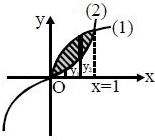
The curve $y=\sqrt{x}$ is $y^{2}=x ;(y \geq 0) \quad \ldots$ $(i)$

and $y=x^{3}$      .....$(ii)$

Point of intersection are $(0,0) \&(1,1)$

$\therefore $ Required area $ = \int\limits_0^1 {\left( {{{\rm{y}}_2} - {{\rm{y}}_1}} \right)dx} $

$ = \int\limits_0^1 {\left( {\sqrt x  - {x^3}} \right)dx} $

${=\frac{5}{12}}$
Need a full question paper?

Generate a complete, print-ready paper with questions like this in minutes — across 16+ boards, with answer keys.

Start Generating Free

Similar questions

Let $a$ be an integer such that all the real roots of the polynomial $2 x^{5}+5 x^{4}+10 x^{3}+10 x^{2}+10 x+10$ lie in the interval $(a, a+1) .$ Then, $| a |$ is equal to ...... .
The pressure P and volume V of a gas are connected by the relation $\text{PV}^{\frac{1}{4}}=$ constant. The percentage increase in the pressure corresponding to a deminition of $\frac{1}{2}\%$ in the volume is:
  1. $\frac{1}{2}\%$
  2. $\frac{1}{4}\%$
  3. $\frac{1}{8}\%$
  4. $\text{None of these}$
Match the statements given in Column $I$ with the values given in Column $II$
Column $I$ Column $II$
$(A)$ If $\vec{a}=\hat{j}+\sqrt{3} \hat{k}, \vec{b}=-\hat{j}+\sqrt{3} \hat{k}$ and $\vec{c}=2 \sqrt{3} \hat{k}$ form a triangle, then the internal angle of the triangle between $\vec{a}$ and $\vec{b}$ is $(p)$ $\frac{\pi}{6}$
$(B)$ If $\int_a^b(f(x)-3 x) d x=a^2-b^2$, then the value of $f\left(\frac{\pi}{6}\right)$ is $(q)$ $\frac{2 \pi}{3}$
$(C)$ The value of $\frac{\pi^2}{\ln 3} \int_{1 / 6}^{5 / 6} \sec (\pi x) d x$ is $(r)$ $\frac{\pi}{3}$
$(D)$ The maximum value of $\left|\operatorname{Arg}\left(\frac{1}{1-z}\right)\right|$ for $|z|=1, \quad z \neq 1$ is given by $(s)$ $\pi$
  $(t)$ $\frac{\pi}{2}$
The solution of the differential equation $(1 + \cos x)dy = (1 - \cos x)dx$ is
Let a line $L$ pass through the point $P (2,3,1)$ and be parallel to the line $x+3 y-2 z-2=0=x-y+2 z$. If the distance of $L$ from the point $(5,3,8)$ is $\alpha$, then $3 \alpha^2$ is equal to $......$.
$\int\frac{2}{(\text{e}^{\text{x}}+\text{e}^{-\text{x}})^2}\text{ dx}=$
  1. $\frac{-\text{e}^{-\text{x}}}{\text{e}^{\text{x}}+\text{e}^{-\text{x}}}+\text{C}$
  2. $-\frac{1}{\text{e}^{\text{x}}+\text{e}^{-\text{x}}}+\text{C}$
  3. $\frac{-1}{(\text{e}^{\text{x}}+1)^2}+\text{C}$
  4. $\frac{1}{\text{e}^{\text{x}}-\text{e}^{-\text{x}}}+\text{C}$
The area of the region bounded by the curves $y = {x^2}$ and $y = \,|x|$ is
If $\int_0^{\frac{\pi }{2}} {\frac{{\cot \,x}}{{\cot \,x + \cos ec\,x}}} dx = m\left( {\pi  + n} \right)$, then $m.n$ is equal to
If $|a|\,\, = 3,\,\,\,|b|\,\, = 4$ and $|a + b|\,\, = 5,$ then $|a - b|\,\, = $
The sum of the order and the degree of the differential equation $\frac{d}{d x}\left(\left(\frac{d y}{d x}\right)^3\right)$ is