MCQ
Area between the curves $y = x^3$ and $y = \sqrt x$ is
  • A
    $\frac{5}{3}$
  • B
    $\frac{5}{4}$
  • $\frac{5}{12}$
  • D
    None

Answer

Correct option: C.
$\frac{5}{12}$
c
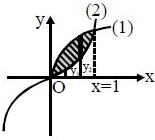
The curve $y=\sqrt{x}$ is $y^{2}=x ;(y \geq 0) \quad \ldots$ $(i)$

and $y=x^{3}$      .....$(ii)$

Point of intersection are $(0,0) \&(1,1)$

$\therefore $ Required area $ = \int\limits_0^1 {\left( {{{\rm{y}}_2} - {{\rm{y}}_1}} \right)dx} $

$ = \int\limits_0^1 {\left( {\sqrt x  - {x^3}} \right)dx} $

${=\frac{5}{12}}$
Need a full question paper?

Generate a complete, print-ready paper with questions like this in minutes — across 16+ boards, with answer keys.

Start Generating Free

Similar questions

If ${\Delta _1} = \left| {\begin{array}{*{20}{c}}
  {{b^5}{c^6}\left( {{c^3} - {b^3}} \right)}&{{a^4}{c^6}\left( {{a^3} - {c^3}} \right)}&{{a^4}{b^5}\left( {{b^3} - {a^3}} \right)} \\ 
  {{b^2}{c^3}\left( {{b^6} - {c^6}} \right)}&{a{c^3}\left( {{c^6} - {a^6}} \right)}&{a{b^2}\left( {{a^6} - {b^6}} \right)} \\ 
  {{b^2}{c^3}\left( {{c^3} - {b^3}} \right)}&{a{c^3}\left( {{a^3} - {c^3}} \right)}&{a{b^2}\left( {{b^3} - {a^3}} \right)} 
\end{array}} \right|$ and ${\Delta _2} = \left| {\begin{array}{*{20}{c}}
  a&{{b^2}}&{{c^3}} \\ 
  {{a^4}}&{{b^5}}&{{c^6}} \\ 
  {{a^7}}&{{b^8}}&{{c^9}} 
\end{array}} \right|$ then ${\Delta _1}{\Delta _2}$ is equal to
$\int_0^{\pi /4} {\frac{{{{\sec }^2}x}}{{(1 + \tan x)(2 + \tan x)}}} \,dx = $
The solution of the differential equation $\frac{dy}{dx}= \frac{y}{(y^2-x)}$ is
The area (in sq. units) of an equilateral triangle inscribed in the parabola $\mathrm{y}^{2}=8 \mathrm{x},$ with one of its vertices on the vertex of this parabola, is 
If $A=\left[\begin{array}{rr}\cos \alpha & -\sin \alpha \\ \sin \alpha & \cos \alpha\end{array}\right]$ and $A+A^{\prime}=I,$ then the value of $\alpha$ is
$\mathop \smallint \limits_{ - \pi /2}^{\pi /2} \frac{{{{\sin }^2}x}}{{1 + {2^x}}}dx =$ . ..  . 
If $ \alpha \leq 2\sin^{-1} \text{x} + \cos^{-1} \text{x}\leq \betaα$ then:
If $P$ be the point $(2, 6, 3)$ then the equation of the plane trough $P,$ at right angles to $OP,$ where $′\ O\ ′$ is the origin is:
The solution of the differential equation $\frac{\text{dy}}{\text{dx}}-\text{Ky}=0, \text{y}(0)=1$ approaches to zero when $\text{x}\rightarrow\propto$ if,
vectors $\vec{\text{a}}$ and $\vec{\text{b}}$ are inclined at angle $\theta=120^\circ.$ if $|\vec{\text{a}}|=1,\big|\vec{\text{b}}\big|=2,$ then $\big[\big(\vec{\text{a}}+3\vec{\text{b}}\big)\times\big(3\vec{\text{a}}-\vec{\text{b}}\big)\big]^2$ is equal to: