MCQ
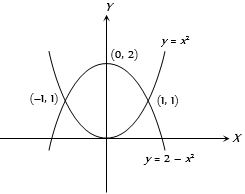
Area bounded by curves $y = {x^2}$ and $y = 2 - {x^2}$ is
 
  • $8/3$
  • B
    $3/8$
  • C
    $3/2$
  • D
    None of these

Answer

Correct option: A.
$8/3$
a
(a) $y = {x^2}$.....$(i)$

$y = 2 - {x^2}$.....$(ii)$

$\therefore $ By equation $(i)$ and $(ii),$ we get,  $x = \pm 1$

$\therefore $ $y = \pm 1$

$\therefore $ Required area $ = 2\left[ {\int_0^1 {(2 - {x^2})dx - \int_0^1 {{x^2}dx} } } \right]$

$ = 2\,\left[ {2x - \frac{{2{x^3}}}{3}} \right]_0^1 = 4\left[ {x - \frac{{{x^3}}}{3}} \right]_0^1 = 4\left( {\frac{2}{3}} \right) = \frac{8}{3}$.
Need a full question paper?

Generate a complete, print-ready paper with questions like this in minutes — across 16+ boards, with answer keys.

Start Generating Free

Similar questions

Let $\alpha, \beta$ be the roots of the equation $x^2-\sqrt{6} x+3=0$ such that $\operatorname{Im}(\alpha)>\operatorname{Im}(\beta)$. Let $a, b$ be integers not divisible by $3$ and $n$ be a natural number such that $\frac{\alpha^{99}}{\beta}+\alpha^{98}=3^n(a+i b), i=\sqrt{-1}$. Then $\mathrm{n}+\mathrm{a}+\mathrm{b}$ is equal to_.....................
If $P\left( \theta  \right) = \left[ {\begin{array}{*{20}{c}}  1&{\cot \theta } \\   { - \cot \theta }&1 \end{array}} \right]$ and $PQ$ = $I$, then $\left( {\cos e{c^2}\theta } \right)Q$  (where $I$ is an identity matrix of $2×2$ order)
The ${n^{th}}$ term of series $\frac{1}{1} + \frac{{1 + 2}}{2} + \frac{{1 + 2 + 3}}{3} + .......$ will be
Let $y(x)$ be the solution of the differential equation $2 x^{2} d y+\left(e^{y}-2 x\right) d x=0, x>0$. If $y(e)=1$, then $\mathrm{y}(1)$ is equal to :
If ${\log _{10}}x = y,$ then ${\log _{1000}}{x^2} $ is equal to
Let $\left\{a_{n}\right\}_{n-1}^{\infty}$ be a sequence such that $a_{1}=1, a_{2}=1$ and $a_{n+2}=2 a_{n+1}+a_{n}$ for all $n \geq 1 .$ Then tha value of $47 \sum_{n=1}^{\infty} \frac{a_{n}}{2^{3 n}}$ is equal to $.....$
Let $M =\left[\begin{array}{cc}0 & -\alpha \\ \alpha & 0\end{array}\right]$, where $\alpha$ is a non-zero real number an $N =\sum\limits_{ k =1}^{49} M ^{2 k }$. If $\left( I - M ^{2}\right) N =-2 I$, then the positive integral value of $\alpha$ is
If $\cos 2B = \frac{{\cos (A + C)}}{{\cos (A - C)}}$, then $\tan A,\;\tan B,\;\tan C$ are in
The vector $\frac{1}{3}\,(2i - 2j + k)$ is
If the function $f\left( x \right) = \left\{ {\begin{array}{*{20}{c}}
  {\frac{{\sqrt {2  + \cos \,x} - 1}}{{\left( {\pi  - {x^2}} \right)}},}&{x \ne \pi } \\ 
  {k\,\,\,\,\,\,\,\,\,\,\,\,\,\,\,\,\,\,\,\,\,,}&{x = \pi } 
\end{array}} \right.$ is continuous at $x\, =\pi $ , then $k$ equals