MCQ
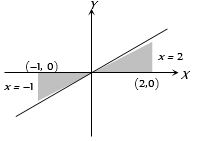
Area bounded by the lines $y = x,\,\,x = - 1,\,\,x = 2$ and $x - $ axis is
  • $\frac{5}{2}\,\, sq. \,unit$
  • B
    $\frac{3}{2}\,\, sq. \,unit$
  • C
    $\frac{1}{2}\,\, sq. \,unit$
  • D
    None of these

Answer

Correct option: A.
$\frac{5}{2}\,\, sq. \,unit$
a
(a) Required area $\int_{ - 1}^2 {\,y\,dx} $

$= \int_{ - 1}^0 {\,y\,.\,dx + \int_0^2 {y\,.\,dx = \frac{5}{2}} } \,\, sq. \,unit$.
Need a full question paper?

Generate a complete, print-ready paper with questions like this in minutes — across 16+ boards, with answer keys.

Start Generating Free

Similar questions

Let $f (x)$ be integrable over $(a, b) , b > a > 0$.

If $I_1 = \int\limits_{\frac{\pi }{6}}^{\frac{\pi }{3}} \, f (\tan\, \theta + \cot\, \theta )\cdot sec^2\, \theta\, d\, \theta$ &

$I_2 = \int\limits_{\frac{\pi }{6}}^{\frac{\pi }{3}} \, f (\tan\, \theta + \cot\, \theta )\cdot cosec^2\, \theta\, d \, \theta$ ,

then the ratio $\frac{{{I_1}}}{{{I_2}}}$ :

$\int_{}^{} {\sqrt {2 + \sin 3x} \;.\;\cos 3x\;dx = } $
If $\text{f}(\text{x})=\sqrt{\text{x}^2+6\text{x}+9},$ then f'(x) is equal to:
  1. 1 for x < -3
  2. -1 for x < -3
  3. 1 for all $\text{x}\in\text{R}$
  4. None of these.
Function f(x) = 2x3 - 9x2 + 12x + 29 is monotonically decreasing when:
  1. x < 2
  2. x > 2
  3. x > 3
  4. 1 < x < 2
Let $y = f (x)$ and $y = g (x)$ be two differentiable function in $[0,2]$ such that  $f(0) = 3,$ $f(2) = 5$ , $g (0) = 1$ and $g(2) = 2$. If there exist atlellst one $c \in \left( {0,2} \right)$ such that $f'(c)=kg'(c)$,then $k$ must be
If the two lines $l_{1}: \frac{ x -2}{3}=\frac{ y +1}{-2}, z =2$ and $l_{2}: \frac{x-1}{1}=\frac{2 y+3}{\alpha}=\frac{z+5}{2}$ perpendicular, then an angle between the lines $l_{2}$ and $l_{3}: \frac{1- x }{3}=\frac{2 y -1}{-4}=\frac{ z }{4}$ is
Choose the correct answer from the given four options.

The domain of the function cos-1(2x - 1) is:

  1. $[0,1]$

  2. $[-1,1]$

  3. $(-1,1)$

  4. $[0,\pi]$

The differential equation of all straight lines passing through the point $(1,\, - 1)$ is
If $y = {\cot ^{ - 1}}({x^2})$, then ${{dy} \over {dx}}$ is equal to
The value of $\cot \left( {\sum\limits_{n = 1}^{19} {{{\cot }^{ - 1}}\left( {1 + \sum\limits_{p = 1}^n {2p} } \right)} } \right)$ is