MCQ
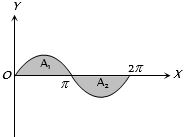
Area bounded by $y = x\sin x$ and $x - $ axis between $x = 0$ and $x = 2\pi ,$ is
  • A
    $0$
  • B
    $2\pi \,\, sq. \,unit$
  • C
    $\pi \,\, sq. \,unit$
  • $4\pi \,\, sq. \,unit$

Answer

Correct option: D.
$4\pi \,\, sq. \,unit$
d
(d) Required area is ${A_1} + {A_2}$

$= \int_0^\pi {y\,\,dx + \left| {\int_\pi ^{2\pi } {y\,dx} } \right| = 4\pi \,sq.} \,unit$
Need a full question paper?

Generate a complete, print-ready paper with questions like this in minutes — across 16+ boards, with answer keys.

Start Generating Free

Similar questions

Given that $\int\limits^{\infty}_0\frac{\text{x}^2}{(\text{x}^2+\text{a}^2)(\text{x}^2+\text{b}^2)(\text{x}^2+\text{c}^2)}\text{ dx}=\frac{\pi}{2(\text{a}+\text{b})(\text{b}+\text{c})(\text{c}+\text{a})},$ the value of $\int\limits^\infty_0\frac{1}{(\text{x}^2+4)(\text{x}^2+9)},$ is:
$\int\big(1+5\text{x}+10\text{x}^2+10\text{x}^3+5\text{x}^4+\text{x}^5\big)\text{dx}=\frac{(1+\text{x})\text{p}}{6}+\text{c}$ then p is:
If $\text{y}=\text{e}^{-\text{x}}(\text{A}\cos\text{x}+\text{B}\sin\text{x}),$ then $y$ is a solution of:
Suppose  $f $ is such that $f( - x) = - f(x)$ for every real $x$ and $\int_{\,0}^{\,1} {f(x)\,dx = 5,} $ then $\int_{\, - \,1}^{\,0} {f(t)\,dt = } $
The law a + b = b + a is called:
Choose the correct answer in the following : The area of the circle $x^2 + y^2 = 16$ exterior to the parabola $y^2 = 6x$ is:
If $\vec u,\vec v,\vec w $ are non-coplanar vectors and $p,q$ are real numbers,then the equality $[3\vec u \,p\vec v\, p\vec w]^-[p\vec v\, \vec w\, q\vec u]^-[2\vec w\, q\vec v\, q\vec u]=0$ hold for: 
The order and degree of the differential equation $x\frac{{{d^2}y}}{{d{x^2}}} + {\left( {\frac{{dy}}{{dx}}} \right)^2} + {y^2} = 0$ are respectively
What is the value of $\int_{0}^{\frac{ \pi}{2}}\frac{\sqrt{\tan\text{x}}}{\sqrt{\tan}\ \text{x}+\sqrt{\cot}\ \text{x}}\text{dx}?$
Choose the correct answer from the given four options.Let $f : N \rightarrow R$ be the function defined by $\text{f}(\text{x})=\frac{2\text{x}-1}{2}$ and $g : Q \rightarrow R$ be another function defined by $g(x) = x + 2.$ Then $(\text{gof})\frac{3}{2}$ is: