MCQ
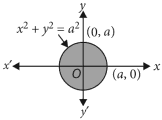
Area enclosed by the circle $x^2+y^2=a^2$ is equal to
  • A
    $2 \pi a^2$ sq. units
  • $\pi a^2$ sq. units
  • C
    $2 \pi a$ sq. units
  • D
    $\pi a$ sq. units

Answer

Correct option: B.
$\pi a^2$ sq. units
We have, $x^2+y^2=a^2$, which is a circle with centre $(0,0)$ and radius $a$.
Image
$\therefore$ Required area $=4 \times$ Area in the first quadrant
$=4 \int_0^a \sqrt{a^2-x^2} d x$
$=4\left[\frac{x}{2} \sqrt{a^2-x^2}+\frac{a^2}{2} \sin ^{-1} \frac{x}{a}\right]_0^a$
$=4\left(\frac{a^2}{2}\right) \frac{\pi}{2}$
$=\pi a^2 \text { sq. units }$

Need a full question paper?

Generate a complete, print-ready paper with questions like this in minutes — across 16+ boards, with answer keys.

Start Generating Free

Similar questions

If $x = 2\cos t - \cos 2t ,$ $y = 2\sin t - \sin 2t$, then at $t = {\pi \over 4},{{dy} \over {dx}} = $
If $(\hat{i}+\lambda \hat{j}) \times(5 \hat{i}+3 \hat{j}+\sigma \hat{k})=0$, what are the values of $\lambda$ and $\sigma$ ?
Let $f: R \rightarrow R$ be defined as $f(x)=x-1$ and $g: R -\{1,-1\} \rightarrow R$ be defined as $g(x)=\frac{x^{2}}{x^{2}-1}$. Then the function fog is
If $A$ and $B$ are two events such that $P\,(A) \ne 0$ and $P\,(B) \ne 1,$ then $P\left( {\frac{{\overline A }}{{\overline B }}} \right) = $
Let $\alpha$ and $\beta$ be the distinct roots of the equation $x^2+x-1=0$. Consider the set $T=\{1, \alpha, \beta\}$. For a $3 \times 3$ matrix $M=\left(a_{\ell}\right) 3 \times 3_3$, define $R_l=a_{l 1}+a_{l 2}+a_\beta$ and $C_j=a_{1 j}+a_{2 l}+a_{3 j}$ for $i=1,2,3$ and $j=1,2,3$

Match each entry in $List-I$ to the correct entry in $List-II$.

$List-I$ $List-II$
($P$) The number of matrices $M=\left(a_{i j}\right)_3 \times 3$ with all entries in $T$ such that $R_i=C_j=0$ for all $i, j$ is ($1$) ($1$)
($Q$) The number of symmetric matrices $M=\left(a_{i j}\right) 3 \times 3$ with all entries in $T$ such that $C_j=0$ for all $j$ is ($2$) ($2$)
($R$) Let $M=\left(a_{i j}\right) 3 \times 3$ be a skew symmetric matrix such that $a_{i j} \in T$ for $i>j$. Then the number of elements in the set $\left\{\left(\begin{array}{l}x \\ y \\ z\end{array}\right): x, y \cdot z \in R, M\left(\begin{array}{l}x \\ y \\ z\end{array}\right)=\left(\begin{array}{c}a_{12} \\ 0 \\ -a_{23}\end{array}\right)\right\}$ is is ($3$) Infinite
($S$) Let $M=\left(a_{i j}\right)_3 \times 3$ be a matrix with all entries in $T$ such that $R_i=0$ for all $i$. Then the absolute value of the determinant of $M$ is ($4$) ($6$)
  ($5$) ($0$)

The correct option is

Let $\overrightarrow{OA}$ and $\overrightarrow{OB}$ be two sides of a triangle. The median $\overrightarrow{AM}$ is perpendicular to angle bisector $\overrightarrow{OL}$ and $\left| \overrightarrow{AM} \right|:\left| \overrightarrow{OL} \right|=1:2$.The angle between $\overrightarrow{OA}$ and $\overrightarrow{OB}$ is
Maximize $Z = 10 x_1 + 25 x_2,$ subject to $0\leq\text{x}_{1}\leq3,0\leq\text{x}_{2}\leq3,\text{x}_{1}+\text{x}_{2}\leq5.$
The possible dimension of a matrix consisting $27$ elements is $4.$Reason: The number of ways of expressing $27$ as a product of two positive integers is $4.$
Which of the following are true ?
If ${a_1},{a_2},{a_3}.....{a_n}....$ are in $G.P.$ then the value of the determinant $\left| {\,\begin{array}{*{20}{c}}{\log {a_n}}&{\log {a_{n + 1}}}&{\log {a_{n + 2}}}\\{\log {a_{n + 3}}}&{\log {a_{n + 4}}}&{\log {a_{n + 5}}}\\{\log {a_{n + 6}}}&{\log {a_{n + 7}}}&{\log {a_{n + 8}}}\end{array}\,} \right|$ is