MCQ
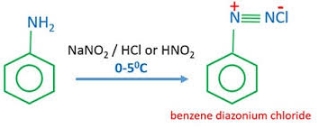
Aromatic primary amine when treated with cold $HN{O_2}$ gives
- ABenzyl alcohol
- BNitro benzene
- CBenzene
- ✓Diazonium salt
Generate a complete, print-ready paper with questions like this in minutes — across 16+ boards, with answer keys.
The limiting ionic conductivity ( $\Lambda 0$ ) values (in $mS m ^2 mol ^{-1}$ ) for different ions in aqueous solutions are given below:
| Ions | $Ag ^{+}$ | $K ^{+}$ | $Na ^{+}$ | $H ^{+}$ | $NO _3^{-}$ | $CI ^{-}$ | $SO _4^{2-}$ | $OH ^{-}$ | $CH_3COO ^{-}$ |
| $\Lambda_0$ | $6.2$ | $7.4$ | $5.0$ | $35.0$ | $7.2$ | $7.6$ | $16.0$ | $19.9$ | $4.1$ |
For different combinations of titrates and titrants given in $List-l$, the graphs of 'conductance' versus 'volume of titrant' are given in $List-II$.
Match each entry in $List-I$ with the appropriate entry in $List-II$ and choose the correct option.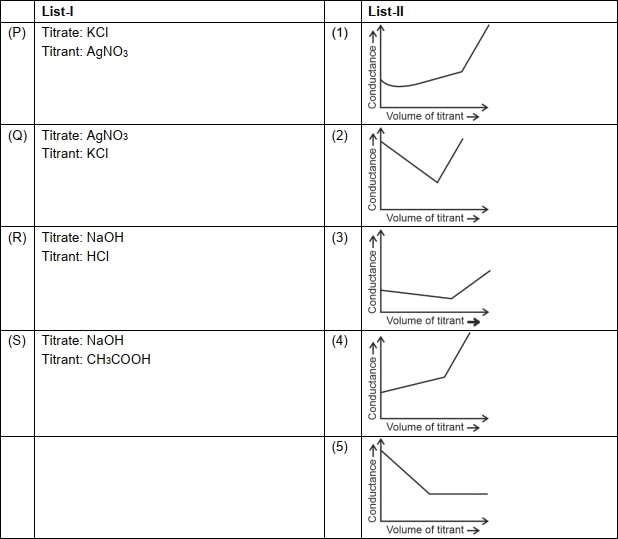
$\mathop {{{(C{H_3})}_3}C\mathop C\limits^ + HC{H_2}Cl}\limits_1 $ $\mathop {{{(C{H_3})}_3}C\mathop C\limits^ + HC{H_3}}\limits_2 $ $\mathop {\begin{array}{*{20}{c}}
{{{(C{H_3})}_2}C\mathop C\limits^ + {{(C{H_3})}_2}} \\
{|\,\,\,\,} \\
{Cl\,\,\,}
\end{array}}\limits_3 $ $\mathop {{{(C{H_3})}_2}\mathop C\limits^ + CH{{(C{H_3})}_2}}\limits_4 $
$A$ and $B$ are :