MCQ
Arrange given amines in decreasing order of their basicity?
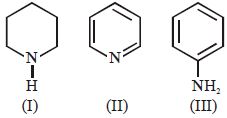
  • $I > II > III$
  • B
    $I > III < II$
  • C
    $III > II > I$
  • D
    $II > I > III$

Answer

Correct option: A.
$I > II > III$
a
$(i)$ In $I$ and $II$ lone pair of electrons on nitrogen is localised but in $III$, it is delocalized

$(ii)$ Hybridization of nitrogen in $I$ is $sp^3$ and in $II$ is $sp^2$

Need a full question paper?

Generate a complete, print-ready paper with questions like this in minutes — across 16+ boards, with answer keys.

Start Generating Free

Similar questions

For the gas phase reaction; 

${C_2}{H_{4(g)}} + {H_{2(g)}} \rightleftharpoons {C_2}{H_{6(g)}}\,;$

$\Delta H = -32.7\,Kcal$ carried out is a vessel, the equilibrium concentration of $C_2H_4$ can be increased by

Which of the following is not halide ore ?
Given below are two statements :

Statement $I$ : Gallium is used in the manufacturing of thermometers.

Statement $II$ : A thermometer containing gallium is useful for measuring the freezing point ( $256 \mathrm{~K}$ ) of brine solution.

In the light of the above statement, choose the correct answer from the options given below :

In which hybridisation angular shape is not possible ?
Ether on heating at high temperature in Presence of air form explosive compound. The structure of this compound is
Which of the following set has the strongest tendency to form anions
The reaction:

$C{H_3}C{H_2}I + KO{H_{(aq)}} \to C{H_3}C{H_2}OH + KI$

is classified as :
After how many seconds will the concentration of the reactants in a first order reaction be halved, if the decay constant is ${\rm{1}}{\rm{.155}} \times {\rm{1}}{{\rm{0}}^{{\rm{ - 3}}}}\,{\sec ^{ - 1}}$ ........... $\sec$
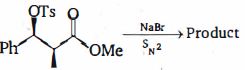
What is the product of the following $S_{N^2}$ reaction ?
$\begin{array}{*{20}{c}}
  {O\,\,\,\,\,\,\,\,\,\,\,\,\,\,\,\,\,\,\,\,\,\,\,\,\,\,\,\,\,\,\,\,\,\,\,\,\,\,\,\,\,\,\,\,\,\,\,\,\,\,\,\,} \\ 
  {||\,\,\,\,\,\,\,\,\,\,\,\,\,\,\,\,\,\,\,\,\,\,\,\,\,\,\,\,\,\,\,\,\,\,\,\,\,\,\,\,\,\,\,\,\,\,\,\,\,\,\,\,} \\ 
  {Ph - C - OH\xrightarrow[\Delta ]{{N{H_3}}}(A){\mkern 1mu} \xrightarrow[{KOH}]{{B{r_2}}}(B),{\mkern 1mu} } 
\end{array}{\mkern 1mu} {\mkern 1mu}$  product $B$  is