MCQ
Arrange these compounds in decreasing order of basic strength
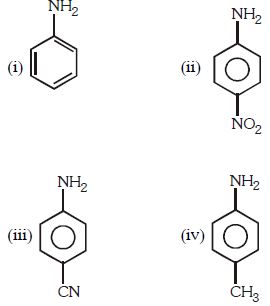
- A$(i) > (ii) > (iii) > (iv)$
- B$(ii) > (iii) > (i) > (iv)$
- ✓$(iv) > (i) > (iii) > (ii)$
- D$(iv) > (i) > (ii) > (iii)$
Generate a complete, print-ready paper with questions like this in minutes — across 16+ boards, with answer keys.

Assume Planck's constant $( h )=6.4 \times 10^{-34}\,Js$ Speed of light $( c )=3.0 \times 10^8\,m / s$ and Avogadro's constant $\left( N _{ A }\right)=6 \times 10^{23} / mol$
| Reaction | Energy Change (in $kJ$ ) |
| $Li(s) \to Li(g)$ | $161$ |
| $Li(g) \to Li^+(g)$ | $520$ |
| $\frac {1}{2}F_2(g)\,\to F(g)$ | $77$ |
| $F(g) + e^- \to F^-(g)$ | (Electron gain enthalpy) |
| $Li^+ (g) + F^-(g) \to LiF(s)$ | $-1047$ |
| $Li (s) + \frac {1}{2}F_2(g)\to LiF(s)$ | $-617$ |
Based on data provided, the value of electron gain enthalpy of fluorine would be.....$kJ\,mol^{-1}$
| column $(I)$ | column $(II)$ | ||
| $(A)$ | Kohlraush law | $(i)$ | $\Lambda _{eq}^o = \Lambda _c^o + \Lambda _a^o$ |
| $(B)$ | Molar Conductivity |
$(ii)$ | $\Lambda _m = \frac{{K \times 1000}}{M}$ |
| $(C)$ | Degree of Dissociation |
$(iii)$ | $\alpha = {\Lambda _m}/\Lambda _m^o$ |
| $(D)$ | Dissociation Constant |
$(iv)$ | ${k_a} = C{\alpha ^2}/1 - \alpha $ |