MCQ
Aryl halides are less reactive towards nucleophilic substitution reaction as compared to alkyl halides due to:
  • A
    The formation of less stable carbonium ion.
  • B
    Longer carbon-halogen bond
  • C
    The inductive effect
  • sp$^2$-hybridised carbon attached to the halogen.
Answer

Correct option: D.
sp$^2$-hybridised carbon attached to the halogen.
Explanation:  d. sp$^2$-hybridised carbon attached to the halogen.
Aryl halides are less reactive towards nucleophilic substitution reaction as compared to alkyl halides due to the following reasons:
Resonance stabilisation.
Sp$^2$-hybridised carbon attached to the halogen.

Need a full question paper?

Generate a complete, print-ready paper with questions like this in minutes — across 16+ boards, with answer keys.

Start Generating Free

Similar questions

The refluxing of ${(C{H_3})_2}NCOC{H_3}$ with acid gives
The correct order in aqueous medium of basic strength in case of methyl substituted amines is :
Find structure which has an organic acid functional group:
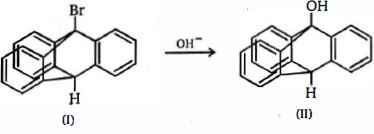
Conversion of $I$ to $II$
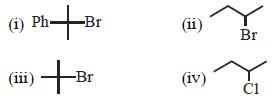
Arrange in order of increasing $S_N1$ reaction rate.
$\begin{matrix}
   C{{H}_{2}}-C{{H}_{2}}-C{{O}_{2}}H\xrightarrow[BaC{{O}_{3}}]{\Delta }A\xrightarrow{N{{H}_{2}}-N{{H}_{2}}}B\xrightarrow[KOH]{heat}(C),  \\
   |\,\,\,\,\,\,\,\,\,\,\,\,\,\,\,\,\,\,\,\,\,\,\,\,\,\,\,\,\,\,\,\,\,\,\,\,\,\,\,\,\,\,\,\,\,\,\,\,\,\,\,\,\,\,\,\,\,\,\,\,\,\,\,\,\,\,\,\,\,\,\,\,\,\,\,\,\,\,\,\,\,\,\,\,\,\,\,\,\,\,\,\,\,\,\,\,\,\,\,\,\,\,\,\,\,\,\,\,\,\,\,\,\,\,\,\,\,\,\,\,\,\,\,\,\,\,\,\,\,\,\,\,  \\
   C{{H}_{2}}-C{{H}_{2}}-C{{O}_{2}}H\,\,\,\,\,\,\,\,\,\,\,\,\,\,\,\,\,\,\,\,\,\,\,\,\,\,\,\,\,\,\,\,\,\,\,\,\,\,\,\,\,\,\,\,\,\,\,\,\,\,\,\,\,\,\,\,\,\,\,\,\,\,\,\,\,\,\,\,\,\,\,\,\,\,\,\,\,\,\,\,\,  \\
\end{matrix}$

Product $(C)$ obtained is

A group of acidic oxide is
Preparation of looking mirrors involves the use of 
Calculate standard free energy change for the reaction $\frac{1}{2}Cu(s) + \frac{1}{2}C{l_2}(g)$ $\rightleftharpoons$ $\frac{1}{2}C{u^{2 + }} + C{l^ - }$ taking place at ${25\,^o}C$ in a cell whose standard e.m.f. is $1.02$  volts .............. $\mathrm{J}$
An acidic solution of dichromate is electrolyzed for $8$ minutes using $2$ $A$ current. As per the following equation

$Cr _{2} O _{7}^{2-}+14 H ^{+}+6 e ^{-} \rightarrow 2 Cr ^{3+}+7 H _{2} O$

The amount of $Cr ^{3+}$ obtained was $0.104\, g$. The

efficiency of the process(in\%) is

(Take : $F =96000\, C$, At. mass of chromium $=52$ )