MCQ
As a wave propagates
  • A
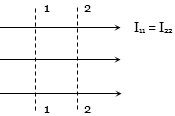
    The wave intensity remains constant for a plane wave
  • B
    Total intensity of the spherical wave over the spherical surface centered at the source remains constant at all times
  • C
    The wave intensity decreases as the inverse square of the distance from the source for a spherical wave
  • All of the above.

Answer

Correct option: D.
All of the above.
d
(d) For a travelling wave, the intensity of wave remainsconstant if it is a plane wave.
Intensity of wave is inversely proportional to the square of the distance from the source if the wave is spherical
$\left( {I = \frac{P}{{4\pi {r^2}}}} \right)$
Intensity of spherical wave on the spherical surface centred at source always remains same. Here total intensity means power $P$.

Need a full question paper?

Generate a complete, print-ready paper with questions like this in minutes — across 16+ boards, with answer keys.

Start Generating Free

Similar questions

The dimensions of entropy are:
A mass $m$ is placed at point $P$ lies on the axis of a ring of mass $M$ and radius $R$ at a distance $R$ from its centre. The gravitational force on mass $m$ is
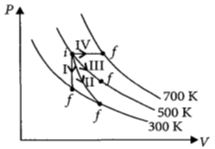
Thermodynamic processes are indicated in the following diagram. 

Match the following

 $\begin{array}{|l|l|} \hline Column\,\,-\,\,1 & Column\,\,-\,\,2 \\ \hline P\,:\,Process\,\,-\,\,I & \,\,A\,\,:\,\,Adiabatic \\ \hline Q\,:\,Process\,\,-\,\,II & \,\,B\,\,:\,\,Isobaric \\ \hline R\,:\,Process\,\,-\,\,III & \,\,C\,\,:\,\,Isochoric \\ \hline S\,:\,Process\,\,-\,\,IV & \,\,D\,\,:\,\,Isothermal \\ \hline \end{array}$


When a car is moving along a circle on a level road, then centripetal force is provided by f, where f denotes as:
A hall has the dimensions $10\,m \times 12\,m \times 14\,m.$A fly starting at one corner ends up at a diametrically opposite corner. What is the magnitude of its displacement...........$m$
The equation of motion of a projectile is:   $y = 12x - \frac{5}{9}{x^2}$. The horizontal component of velocity is $3\ ms^{- 1}$ . Given that $g = 10\ ms^{- 2}$ , .......... $m$ is the range of the projectile .
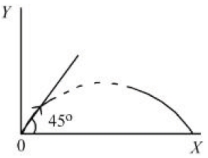
A particle of mass $100\,g$ is projected at time $t =0$ with a speed $20\,ms ^{-1}$ at an angle $45^{\circ}$ to the horizontal as given in the figure. The magnitude of the angular momentum of the particle about the starting point at time $t=2\,s$ is found to be $\sqrt{ K }\,kg\,m ^2 / s$. The value of $K$ is $............$ $\left(\right.$ Take $\left.g =10\,ms ^{-2}\right)$
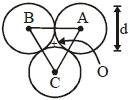
Three solid spheres each of mass $\mathrm{m}$ and diameter $d$ are stuck together such that the lines connecting the centres form an equilateral triangle of side of length $d$. The ratio $\mathrm{I}_{0} / \mathrm{I}_{\mathrm{A}}$ of moment of inertia $\mathrm{I}_{0}$ of the system about an axis passing the centroid and about center of any of the spheres $\mathrm{I}_{\mathrm{A}}$ and perpendicular to the plane of the triangle is
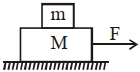
Two blocks $( m =0.5\, kg$ and $M =4.5\, kg$ ) are arranged on a horizontal frictionless table as shown in figure. The coefficient of static friction between the two blocks is $\frac{3}{7} .$ Then the maximum horizontal force that can be applied on the larger block so that the blocks move together is ......... $N.$ (Round off to the Nearest Integer) [Take g as $9.8\, ms ^{-2}$ ]
 A body is performing S.H.M. Then its:
  1. Average total energy per cycle is equal to its maximum kinetic energy.
  2. Average kinetic energy per cycle is equal to half of its maximum kinetic energy.
  3. Mean velocity over a complete cycle is equal to $\frac{2}{\pi}$ times of its maximum velocity.
  4. Root mean square velocity is $\frac{1}{\sqrt{2}}$ times of its maximum velocity.