MCQ
As compared $^{12}C$ atom, $^{14}C$ atom has
  • A
    Two extra protons and two extra electrons
  • B
    Two extra protons but no extra electrons
  • Two extra neutrons and no extra electrons
  • D
    Two extra neutrons and two extra electrons

Answer

Correct option: C.
Two extra neutrons and no extra electrons
c
(c) For $_6{C^{12}},$$p = 6,\;e = 6,\;n = 6$

For $_6{C^{14}},$$p = 6,\;e = 6,\;n = 8$

Need a full question paper?

Generate a complete, print-ready paper with questions like this in minutes — across 16+ boards, with answer keys.
Start Generating Free

Similar questions

The nuclear force between two nucleons is explained by
A capacitor $4\,\mu F$ charged to $50\, V$ is connected to another capacitor of $2\,\mu F$ charged to $100 \,V$ with plates of like charges connected together. The total energy before and after connection in multiples of $({10^{ - 2}}\,J)$ is
A physical quantity of the dimensions of length that can be formed out of $c, G$ and $\frac{e^2}{4\pi \varepsilon _0}$  is $[c$ is velocity of light, $G$ is the universal constant of gravitation and $e$ is charge $] $
If the value of g at the surface of the earth is $9.8$ $m/{\sec ^2}$, then the value of g at a place $480\, km$ above the surface of the earth will be .......... $m/{\sec ^2}$. (Radius of the earth is $6400\, km$)   
The critical angle for a denser-rarer interface is $45^{\circ}$. The speed of light in rarer medium is $3 \times 10^8$ ms. The speed of light in the denser medium is:
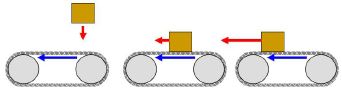
A $300\  kg$ crate is dropped vertically onto a conveyor belt that is moving at $1.20\  m/s$. A motor maintains the belt's constant speed. The belt initially slides under the crate, with a coefficient of friction of $0.400$. After a short time, the crate is moving at the speed of the belt. During the period in which the crate is being accelerated, find the work done by the motor which drives the belt :- ................. $\mathrm{J}$
A hydrogen atom changes its state from $n=3$ to $\mathrm{n}=2$. Due to recoil, the percentage change in the wave length of emitted light is approximately $1 \times 10^{-\mathrm{n}}$. The value of $\mathrm{n}$ is_______.[Given $\mathrm{Rhc}=13.6 \mathrm{eV}, \mathrm{hc}=1242 \mathrm{eV} \mathrm{nm}$, $\mathrm{h}=6.6 \times 10^{-34} \mathrm{~J} \mathrm{~s}$, mass of the hydrogen atom $\left.=1.6 \times 10^{-27} \mathrm{~kg}\right]$
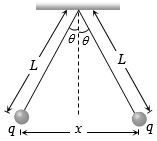
In the given figure two tiny conducting balls of identical mass $m$ and identical charge $q$ hang from non-conducting threads of equal length $L$. Assume that $\theta$ is so small that $\tan \theta \approx \sin \theta $, then for equilibrium $x$ is equal to
A cylinder rolls without slipping down an inclined plane, the number of degrees of freedom it has, is
A tuning fork of unknown frequency makes $3\,beats/sec$ with a standard fork of frequency $384\,Hz$ . The beat frequency decreases when a small piece of wax is put on the prong of the first. The frequency of the fork is  .... $Hz$