MCQ
As compared to $^{12}C$ atom $,^{14}C$ atom has:
  • A
    Two extra protons and two extra electrons.
  • B
    Two extra protons but no extra electron.
  • Two extra neutrons and no extra electron.
  • D
    Two extra neutrons and two extra electrons.

Answer

Correct option: C.
Two extra neutrons and no extra electron.
$^{12}C$ and $^{14}C$ are the two isotopes of carbon atom that have same atomic number, but different mass numbers. This means that they have same number of protons and electrons, but different number of neutrons.
Therefore $^{12}C$ has $6$ protons$, 6$ electrons and $6$ neutrons, whereas ​$^{14}C$ has $6$ electrons$, 6$ protons and $8$ neutrons.

Need a full question paper?

Generate a complete, print-ready paper with questions like this in minutes — across 16+ boards, with answer keys.
Start Generating Free

Similar questions

The curve of binding energy per nucleon as a function of atomic mass number has a sharp peak for helium nucleus. This implies that helium?
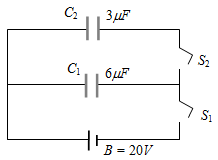
In the circuit shown here $C_1=6 \mu F, C_2=3 \mu F$ and battery $B=20 V$. The switch $S_1$ is first closed. It is then opened and afterwards $S_2$ is closed. What is the charge finally on $C _2$
The ratio activity of an element becomes $1/64^{th}$ of its original value in $60\ \sec$. Then the half life period is
The thermal radiation emitted by a body is proportional to $T^n$ where Tis its absolute temperature. The value of $n$ is exactly $4$ for:
10 gm of radioactive material of half-life 15 year is kept in store for 20 years. The disintegrated material is(a) 12.5 g(b) 10.5 g(c) 6.03 g(d) 4.03 g
       
The energy of an $X-$ray photon of wavelength $1.65 A \text { is }\left(h=6.6 \times 10^{-34} J-\sec, 1 eV=1.6 \times 10^{-19} J\right)$
An electron moving towards the east enters a magnetic field directed towards the north. The force on the electron will be directed (a) Vertically upward(b) Vertically downward(c) Towards the west(d) Towards the south
   
   
X-rays are not used for radar purpose because(a) They are not reflected by the target(b) They are not electromagnetic waves(c) They are completely absorbed by the air(d) They sometimes damage the target


An electron is moving towards x-axis. An electric field is along y-direction then path of electron is (a) Circular(b) Elliptical(c) Parabola(d) None of these
       
Excitation energy of a hydrogen like ion in its excitation state is 40.8 eV. Energy needed to remove the electron from the ion in ground state is: