- ALow melting points and low boiling points
- BLow melting points and high boiling points
- CHigh melting points and low boiling points
- ✓High melting points and high boiling points
Generate a complete, print-ready paper with questions like this in minutes — across 16+ boards, with answer keys.
$(1)$ $C{H_2} = C{H_2}$
$(2)$ ${(C{H_3})_2}C = C{H_2}$
$(3)$ $C{H_3}CH = CHC{H_3}$
${{C}_{6}}{{H}_{5}}OH\xrightarrow{NaOH}(A)$ $\mathop {\xrightarrow{{\;C{O_2}\;\;\;\;\;\;\;\;\;\;\;\;}}}\limits_{140\,^oC,\;(4 - 7\,)} (B)$ $\xrightarrow{{HCl}}(C),$
$({K_c} = 1.8 \times {10^{ - 6}}\,{\rm{at}}\,\,184\,^\circ C)$
$(R = 0.0831\,kJ/\,(mol.\,K))$
When ${K_p}$ and ${K_c}$ are compared at $184\,^oC$ it is found that
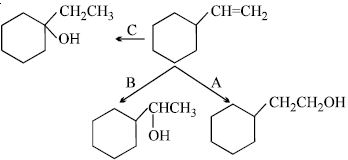
$I-$ acid catalysed hydration
$II-$ $HBO$
$III-$ oxymercuration-demercuration
How can this reaction is made to proceed in forward direction?
$(i)$ ${C_4}{H_5}N{H_2}$ $(ii)$ $C{H_3}N{H_2}$
$(iii)$ ${(C{H_3})_2}NH$ $ (iv)$ ${(C{H_3})_3}N$