MCQ
As electron moves away from the nucleus, its potential energy
  • Increases
  • B
    Decreases
  • C
    Remains constant
  • D
    None of these

Answer

Correct option: A.
Increases
a
An electron moves away from the nucleus, its potential energy increases. The potential energy of the electron is minimum at equilibrium distance from the nucleus. As this distance increases / decreases, its potential energy increases.

Thus, when electron is excited a higher energy orbital it gets farther away from the atom. The further the orbital is from the nucleus, the higher the potential energy of an electron at that energy level.

Need a full question paper?

Generate a complete, print-ready paper with questions like this in minutes — across 16+ boards, with answer keys.

Start Generating Free

Similar questions

In a reaction, if half of the double bond is broken and two new bonds are formed, this is a case of
For a chemical reaction $A+B \rightleftharpoons C+D$ $\left(\Delta_{r} H^{0}=80 \,k J\right.$ $mol\,^{-1}$ ) the entropy change $\Delta_{r} S^{0}$ depends on the temperature $T$ (in $K$ ) as $\left(\Delta_{ r } S ^{0}=2 T \left(\, J \,K ^{-1}\, mol ^{-1}\right)\right.$

Minimum temperature at which it will become spontaneous is ..... $K.$(Integer)
Amongest following the lowest degree of paramagnetism per mole of the compound at $298 K$  will be shown by
Pure water is kept in a vessel and it remains exposed to atmospheric $C{O_2}$ which is absorbed, then its $pH$  will be
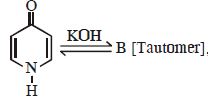
$B$ is
The vapour pressure of water at $20\,^o C$ is $17.5\, mm\, Hg.$ If $18\, g$ of glucose $(C_6H_{12}O_6)$ is added to $178.2\, g$ of water at $20\,^o C,$ the vapour pressure of the resulting solution will be.........$\,mm\, of Hg$
The instantaneous rate of disappearance of $MnO_4^-$ ion in the following reaction is $4.56 \times 10^{-3}\, Ms^{-1}$

$2MnO_4^ -  + 10{I^ - } + 16{H^ + } \to 2M{n^{2 + }} + 5{I_2} + 8{H_2}O$

The rate of appearance $I_2$ is......$\times {10^{ - 2}}\,M{s^{ - 1}}$

Choose the best synthesis of phenyl $n$ -propyl ether.
For a chemical reaction $A + B \rightarrow$ Product, the order is $1$ with respect to $A$ and $B$.

Rate $mol\,L^{-1}\,s^{-1}$ $[A]$ $mol\,L^{-1}$ $[B]$ $mol\,L^{-1}$
$0.10$ $20$ $0.5$
$0.40$ $x$ $0.5$
$0.80$ $40$ $y$

What is the value of $x$ and $y ?$

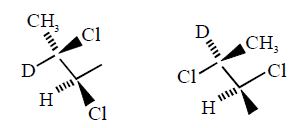
How are the following compounds related