MCQ
As the intensity of incident light increases
  • Photoelectric current increases
  • B
    Photoelectric current decreases
  • C
    Kinetic energy of emitted photoelectrons increases
  • D
    Kinetic energy of emitted photoelectrons decreases

Answer

Correct option: A.
Photoelectric current increases
Intensity increases means more photons of same energy will emit more electrons of same energy, hence only photoelectric current increases.

Need a full question paper?

Generate a complete, print-ready paper with questions like this in minutes — across 16+ boards, with answer keys.
Start Generating Free

Similar questions

Every atom makes one free electron in copper. If 1.1 ampere current is flowing in the wire of copper having 1 $\mathrm{mm}$ diameter, then the drift velocity (approx.) will be (Density of copper $=9 \times 10^3 \mathrm{~kg} \mathrm{~m}^{-3}$ and atomic weight $(=63)$
An earth satellite of mass $m$ revolves in a circular orbit at a height $h$ from the surface of the earth. $R$ is the radius of the earth and $g$ is acceleration due to gravity at the surface of the earth. The velocity of the satellite in the orbit is given by
Two identical batteries, each of e.m.f. 2 volt and internal resistance 1.0 ohm are available to produce heat in an external resistance $R=0.5 ohm$ by passing a current through it. The maximum Joulean power that can be developed across $R$ using these batteries is
Angular width of central maxima in the Fraunhoffer diffraction pattern of a slit is measured. The slit is illuminated by light of wavelength $6000 \mathring A$. When the slit is illuminated by light of another wavelength, the angular width decreases by $30 \%$. The wavelength of this light will be
The reactance of a coil when used in the domestic ac power supply $(220$ volt, $50$ cycles $)$ is $100$ ohm. The self inductance of the coil is nearly
In Thomson's experiment if the value of $q / m$ is the same for all positive ions striking the photographic plate, then the trace would be
The maximum speed that can be achieved without skidding by a car on a circular unbanked road of radius $R$ and coefficient of static friction $\mu$, is
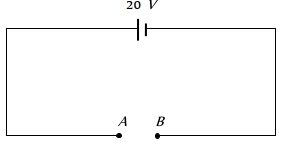
In the shown circuit, what is the potential difference across $A$ and $B$

Image

Which of the following is not the unit of time
When a resistance of $5\,\Omega$ is shunted with a moving coil galvanometer, it shows a full scale deflection for a current of $250\,mA$, however when $1050\,\Omega$ resistance is connected with it in series, it gives full scale deflection for $25$ volt. The resistance of galvanometer is $......\,\Omega$.