Question
Asolid disc and a ring, both of radius 10cm are placed on a horizontal table simultaneously, with initial angular speed equal to $10\pi\  rad\  s^{-1}?.$ Which of the two will start to roll earlier? The coefficient of kinetic friction is

Answer

As motion starts due to friction, F = ma $\Rightarrow\mu_{\text{k}}\text{mg}=\text{ma}$
$\Rightarrow\text{a}=\mu_{\text{k}}\text{g}$ Torque due to friction $\tau=\text{I}\alpha$ $\Rightarrow\mu_{\text{k}}\text{mgR}=\text{I}\alpha$
$\Rightarrow\alpha=\frac{\mu_{\text{k}}\text{mgR}}{\text{I}}$ Rolling begins, when $\text{v}=\omega\text{R}$But $\text{v}=0+\alpha\text{t}$
$\Rightarrow\text{v}=\mu_{\text{k}}\text{gt}$
and $\omega=\omega_0+\alpha\text{t}$
$\omega=\omega_0-\frac{\mu_{\text{k}}\text{mgR}}{\text{I}}\text{t}$
$\Rightarrow\frac{\text{v}}{\text{R}}=\omega_0\frac{\mu_{\text{k}}\text{mgR}}{\text{I}}\text{t}$
$\Rightarrow\text{t}=\frac{\text{R}\omega_0}{\mu_{\text{k}}\text{g}\Big(\frac{\text{I}+\text{mR}^2}{\text{I}}\Big)}$ For disc, $\text{I}=\text{mR}^2$
$\Rightarrow\text{t}=0.53\text{s}$ For ring, $\text{I}=\text{mR}^2$ $\Rightarrow\text{t}=0.80\text{s}$Thus, disc begins to roll earlier.

Need a full question paper?

Generate a complete, print-ready paper with questions like this in minutes — across 16+ boards, with answer keys.
Start Generating Free

Similar questions

The principle of ‘parallax’ in section $2.3.1$ is used in the determination of distances of very distant stars. The baseline AB is the line joining the Earth’s two locations six months apart in its orbit around the Sun. That is, the baseline is about the diameter of the Earth’s orbit $\approx 3 \times 10^{11}m$. However, even the nearest stars are so distant that with such a long baseline, they show parallax only of the order of $1”$ (second) of arc or so. A parsec is a convenient unit of length on the astronomical scale. It is the distance of an object that will show a parallax of $1”$ (second of arc) from opposite ends of a baseline equal to the distance from the Earth to the Sun. How much is a parsec in terms of metres?
Suppose white light falls on a double slit but one slit is covered by a violet filter (allowing $\lambda=400\text{nm}$). Describe the nature of the fringe pattern observed.
When you lift a box from the floor and put it on an almirah the potential energy of the box increases, but there is no change in its kinetic energy. Is it a violation of conservation of energy?
Two circular loops are placed coaxially but separated by a distance. A battery is suddenly connected to one of the loops establishing a current in it. Will there be a current induced in the other loop? If yes, when does the current start and when does it end? Do the loops attract each other or do they repel?
The planet Saturn has a mass $95$ times that of the earth, and its radius is $9.5$ times the earth's radius. Calculate the escape speed of a body from Saturn's surface, if the escape speed from the earth's surface is $11.2kms^{-1}$.
Plot the corresponding reference circle for each of the following simple harmonic motions. Indicate the initial (t = 0) position of the particle, the radius of the circle, and the angular speed of the rotating particle. For simplicity, the sense of rotation may be fixed to be anticlockwise in every case: (x is in cm and t is in s).$\text{x}=\cos\Big(\frac{\pi}{6}-\text{t}\Big)$
A physical quantity P is related to four observables a, b, c and d as follows: $\text{P}=\text{a}^3\text{b}^3/\big(\sqrt{\text{c}}\text{ d}\big)$ The percentage errors of measurement in a, b, c and d are 1%, 3%, 4% and 2%, respectively. What is the percentage error in the quantity P ? If the value of P calculated using the above relation turns out to be 3.763, to what value should you round off the result ?
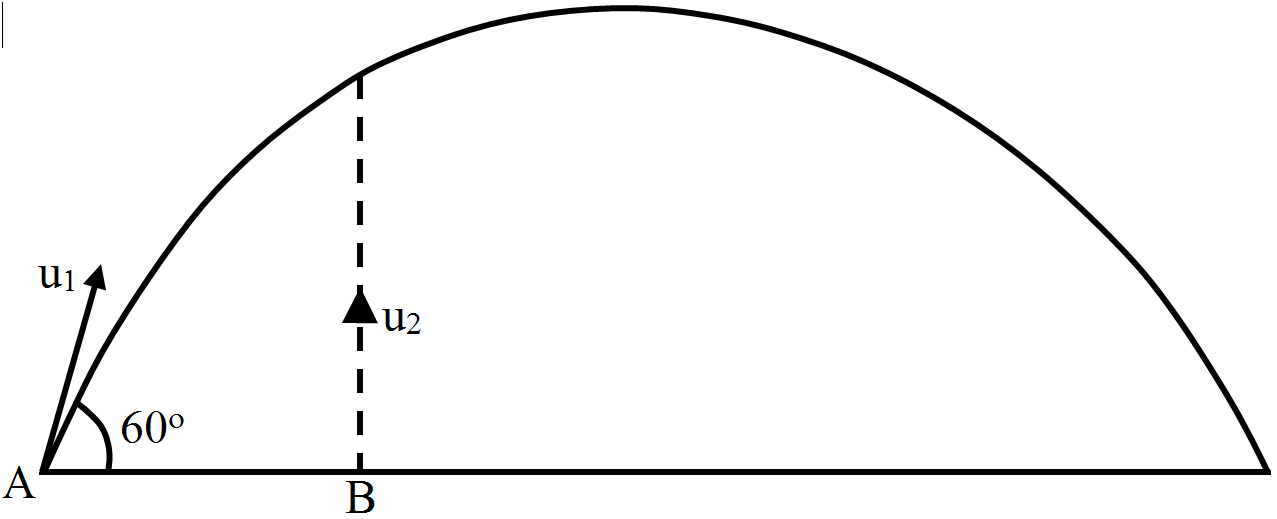
A body is projected with the velocity $u_1$ from the point A as shown in figure. At the same time another body is projected vertically upwards with the velocity $u_2$ from the point B. What should be the value of $\frac{\text{u}_1}{\text{u}_2}$ for both the bodies to collide?
A body of mass M at rest is struck by a moving body of mass m. Show that the fraction of the initial kinetic energy of moving mass m transferred to the struck body is $4Mm /(m + M)^2.$
The measured value of length, breadth and height of a block of wood along with maximum permissible errors are expressed as follows:$\text{I}=12.80\pm0.01\text{cm},$ $\text{b}=10.12\pm0.01\text{cm}$ $\text{h}=5.26\pm0.01\text{cm}$ Calculate the percentage error in the volume of the block.