MCQ
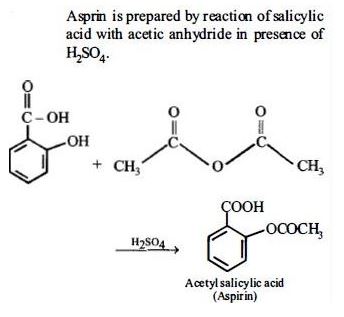
Aspirin can be prepared by the reaction of
  • A
    Salicyldehyde with acetic anhydride in presence of $H_2SO_4$
  • B
    Salicylic acid with methanol in presence of $H_2SO_4$
  • Salicylic acid with acetic anhydride in presence of $H_2SO_4$
  • D
    Cinnamic acid with acetic anhydride in presence of $H_2SO_4$

Answer

Correct option: C.
Salicylic acid with acetic anhydride in presence of $H_2SO_4$
c

Need a full question paper?

Generate a complete, print-ready paper with questions like this in minutes — across 16+ boards, with answer keys.

Start Generating Free

Similar questions

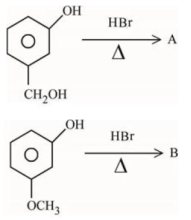
'$A$' and ' $B$ ' formed in the following set of reactions are :
$\text{IUPAC}$ name of $\left[\mathrm{Pt}\left(\mathrm{NH}_3\right)_2 \mathrm{Cl}\left(\mathrm{NO}_2\right)\right]$ is:
When ethyl alcohol $({C_2}{H_5}OH)$ reacts with thionyl chloride, in the presence of pyridine, the product obtained is
$ \text{IUPAC}$ name of m$-$cresol is $......$
Given below are two statements

Statement $I : CeO _{2}$ can be used for oxidation of aldehydes and ketones.

Statement $II :$ Aqueous solution of $EuSO _{4}$ is a strong reducing agent.

In the light of the above statements, choose the correct answer from the options given below

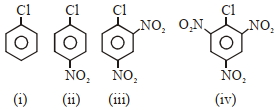
The correct order of the following compounds showing increasing tendency towards nucleophilic substitution reaction is :-
On passing $ 3$  ampere of electricity for  $ 50$  minutes, $1.8 $ gram metal deposits. The equivalent mass of metal is
Select correct statement about anionic part of Zeise’s salt, $K\left[ {Pt\left( {{\eta ^2} - {C_2}{H_4}} \right)C{l_3}} \right]$ 
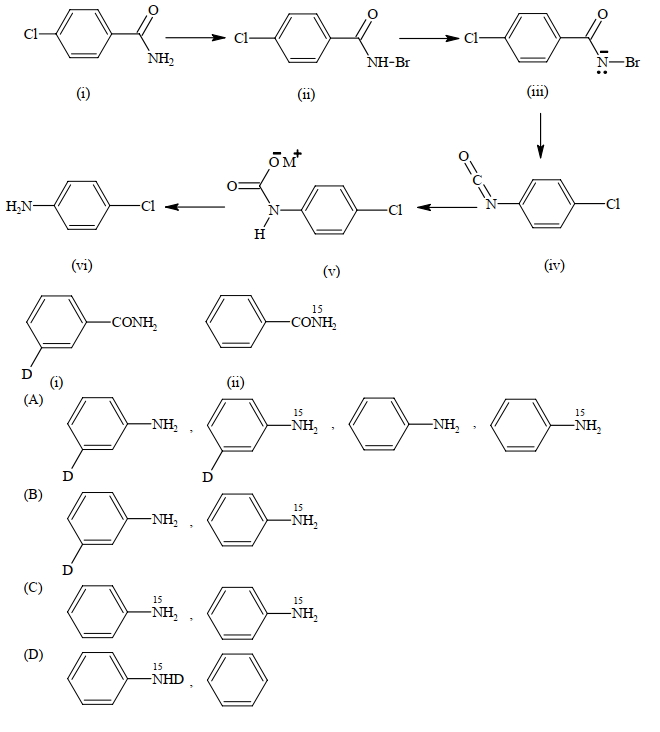
$\mathrm{RCONH}_2$ is converted into $\mathrm{RNH}_2$ by means of Hofmann bromamide degradation.

$Image$

In this reaction, $\mathrm{RCONHBr}$ is formed from which this reaction has derived its name. Electron donating group at phenyl activates the reaction. Hofmann degradation reaction is an intramolecular reaction.

$1.$  How can the conversion of $(i)$ to $(ii)$ be brought about?

$(A)$ $\mathrm{KBr}$  $(B)$ $\mathrm{KBr}+\mathrm{CH}_3 \mathrm{ONa}$  $(C)$ $\mathrm{KBr}+\mathrm{KOH}$  $(D)$ $\mathrm{Br}_2+\mathrm{KOH}$

$2.$  Which is the rate determining step in Hofmann bromamide degradation?

$(A)$ Formation of $(i)$  $(B)$ Formation of $(ii)$  $(C)$ Formation of $(iii)$  $(D)$ Formation of $(iv)$

$3.$  What are the constituent amines formed when the mixture of $(i)$ and $(ii)$ undergoes Hofmann bromamide degradation?

$Image$

give the answer question $1$, $2$, and $3.$
Coordination number of $Zn$  in $ZnS $ (zinc blende) is