Question
Assertion $(A) : A=\left[\begin{array}{ll}2 & 3 \\ 1 & 4\end{array}\right], B=\left[\begin{array}{ll}1 & 0 \\ 0 & 1\end{array}\right]$, then $(A+B)^2=A^2+B^2+2 A B$.
Reason $(R)$: For the matrices $A$ and $B$ given in assertion, $A B=B A$.
Answer

$ A=\left[\begin{array}{ll}2 & 3 \\ 1 & 4\end{array}\right] $ and $B=\left[\begin{array}{ll}1 & 0 \\ 0 & 1\end{array}\right]=I $
$ A B=A I=A $ and $ B A=I A=A $
$ \Rightarrow A B=B A$
Consequently, $(A+B)^2=(A+B)(A+B) $
$=A(A+B)+B(A+B)=A^2+A B+B A+B^2 $
$=A^2+A B+A B+B^2=A^2+2 A B+B^2$

Need a full question paper?

Generate a complete, print-ready paper with questions like this in minutes — across 16+ boards, with answer keys.

Start Generating Free

Similar questions

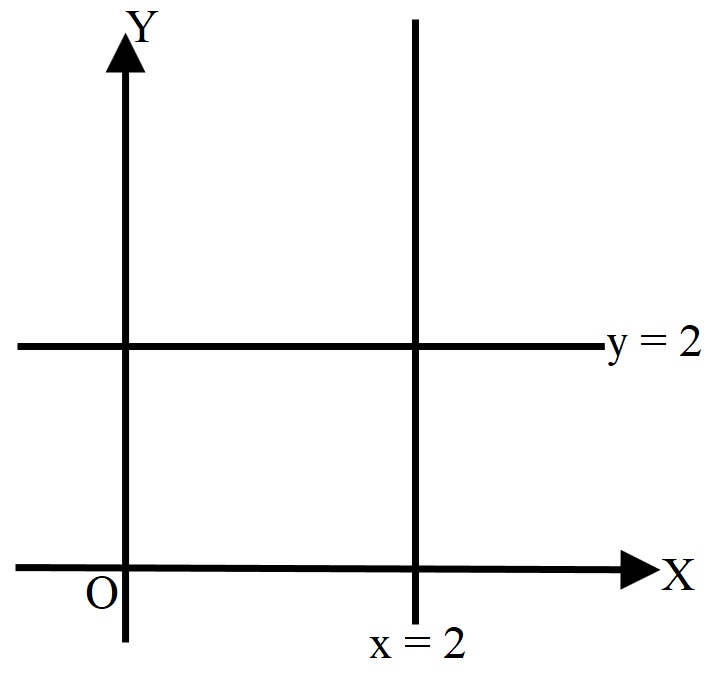
Directions: In the following questions, the Assertions (A) and Reason(s) (R) have been put forward. Read both the statements carefully and choose the correct alternative from the following Assertion (A): The graph of $\text{x}\leq2$ and $\text{y}\geq2$ will be situated in the first and second quadrants. Reason (R):
  1. Both A and R are true and R is the correct explanation of A
  2. Both A and R are true but R is NOT the correct explanation of A
  3. A is true but R is false.
  4. A is false but R is true.
Directions: In the following questions, a statement of assertion (A) is followed by a statement of reason (R). Mark the correct choice as:
Assertion: The value of x for which $\begin{vmatrix}3&\text{x}\\\text{x}&1\end{vmatrix}=\begin{vmatrix}3&2\\4&1\end{vmatrix}$ is $\pm2\sqrt{2}.$
Reason: The determinant of a matrix A order 2x2, $\text{A}\begin{bmatrix}\text{a}&\text{b}\\\text{c}&\text{d}\end{bmatrix}$ is = ad - bc.
  1. Both A and R are true and R is the correct explanation of A.
  2. Both A and R are true but R is not the correct explanation of A.
  3. A is true but R is false.
  4. A is false but R is true.
  5. Both A and R are false.
Directions: In the following questions, a statement of assertion $(A)$ is followed by a statement of reason $(R)$. Mark the correct choice as:
Assertion: If $\text{A}=\begin{pmatrix}0&-2&3\\ 2&0&6\\-3&-6&0 \end{pmatrix},$ then $A^{-1}$ does not exist.
Reason: If $A$ is a skew symmetric matrix of odd order, then $A$ is singular.
Directions: In the following questions, a statement of assertion (A) is followed by a statement of reason (R). Mark the correct choice as:
Assertion: If $0<\text{x}\leq\frac{\pi}{2},$ then $\sin^{-1}(\cos\text{x})+\cos^{-1}(\sin\text{x})=\pi-2\text{x}.$
Reason: $\cos^{-1}\text{x}=\frac{\pi}{2}-\sin^{-1}\text{x} $ for all $\text{x}\in[-1,1].$
  1. Both A and R are true and R is the correct explanation of A.
  2. Both A and R are true but R is not the correct explanation of A.
  3. A is true but R is false.
  4. A is false but R is true.
  5. Both A and R are false.
Directions: In the following questions, a statement of assertion (A) is followed by a statement of reason (R). Mark the correct choice as:
Assertion: $\cos^{-1}\text{x}-\sin^{-1}\text{x}=0,$ then $\text{x}=\frac{1}{\sqrt{2}}.$
Reason: $\cot^{-1}\text{x}+\sin^{-1}\text{x}=\frac{\pi}{2}.$ 
  1. Both A and R are true and R is the correct explanation of A.
  2. Both A and R are true but R is not the correct explanation of A.
  3. A is true but R is false.
  4. A is false but R is true.
  5. Both A and R are false. 
Assertion (A) : $B=\left[\begin{array}{llll}-\frac{1}{2} & \sqrt{5} & 2 & 3\end{array}\right]_{1 \times 4}$ is a row matrix.
Reason (R): If $B=\left[b_{i j}\right]_{1 \times n}$ is a row matrix, then its order is $n \times 1$.
Assertion $(A) :$ The area of the region bounded by the curve $y^2=4 x$ and the line $x=3$ is $8 \sqrt{3}$ sq. units.
Reason $(R):$ The area is symmetric about $x$ and $y$ axes.
Assertion (A): $\left[\begin{array}{lll}3 & 0 & 0 \\ 0 & 4 & 0 \\ 0 & 0 & 7\end{array}\right]$ is a diagonal matrix.
Reason (R): $A=\left[a_{i j}\right]_{n \times n}$ is a square matrix such that $a_{i j}=0, \forall i \neq j$, then $A$ is called diagonal matrix.
Assertion (A) : Scalar matrix $A=\left[a_{i j}\right]$ $=\left\{\begin{array}{ll}k ; & i=j \\ 0 ; & i \neq j\end{array}\right.$ where $k$ is a scalar, is an identity matrix when $k=1$.
Reason (R) : Every identity matrix is not a scalar matrix.
A man $P$ speaks truth with probability $p$ and an other $\operatorname{man} Q$ speaks truth with probability $2 p$.
Assertion $(A) :$ If $P$ and $Q$ contradict each other with probability $1 / 2$, then there are two values of $p$.
Reason $(R) :$ A quadratic equation with real coefficients has two real roots.