MCQ
Assertion $(A)$ : Consider the following frequency distribution:"
Class interval $3-6$ $6-9$ $9-12$ $12-15$ $15-18$ $18-21$
Frequency $2$ $5$ $21$ $23$ $10$ $12$
The mode of the above data is $12.4$.
Reason $(R)$ : The value of the variable which occurs most often is the mode.
  • A
    Both Assertion $(A)$ and Reason $(R)$ are true and Reason $(R)$ is a correct explanation of Assertion $(A)$.
  • Both Assertion $(A)$ and Reason $(R)$ are true but Reason $(R)$ is a not a correct explanation of Assertion $(A)$.
  • C
    Assertion $(A)$ is true and Reason $(R)$ is false.
  • D
    Assertion $(A)$ is false and Reason $(R)$ is true
Answer

Correct option: B.
Both Assertion $(A)$ and Reason $(R)$ are true but Reason $(R)$ is a not a correct explanation of Assertion $(A)$.
Reason $(R)$ is true.
Maxximum frequency $= 23$
Hence, modakl class is $12-15$
Now, mode $=\text{x}_\text{k}+\text{h}\Big\{\frac{(\text{f}_\text{k}-\text{f}_{\text{k}-1})}{(2\text{f}_\text{k}-\text{f}_{\text{k}-1}-\text{f}_{\text{k}+1})}\Big\}$
$=12+3\Big\{\frac{(23-21)}{(2(23)-21-10)}\Big\}$
$=12+3\times\frac{2}{15}$
$=12+0.4$
$=12.4$
Thus, Assertion $(A)$ and Reason $(R)$ are both true but Reason $(R)$ rs nor !he eereee explananoon of Assertion $(A)$.

Need a full question paper?

Generate a complete, print-ready paper with questions like this in minutes — across 16+ boards, with answer keys.

Start Generating Free

Similar questions

The least perfect square number which is divisible $3,4,5,6$ and $8$ is
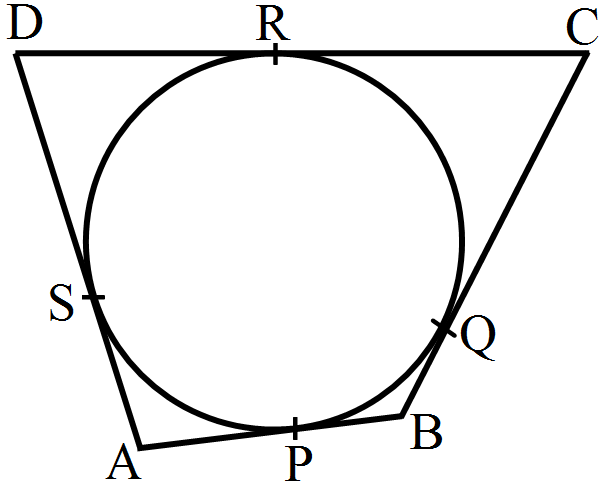
Assertion $(A) :$ In the given figure, $a$ quad. $ABCD$ is drawn to circumscribe a given circle as shown.

Reason $(R) :$ In two concentric circles, the chord of the larger circle, which to uches the smaller circle, is bisected at the point of contact.
Assertion $(A)$ : If the radii of the circular ends of a bucket $24\ cm$ high are $15\ cm$ and $5\ cm$ respectively, then the surface area of the bucket is $545\pi\text{cm}^2.$
Reason $(R)$ : if the radii of the circular ends of the frustum of a cone are R and r respectively and its height is h, surface area is:$\pi\big\{\text{R}^2+\text{r}^2+\text{l}(\text{R}-\text{r})\big\}$where $\text{l}^2=\text{h}^2+(\text{R}+\text{r})^2.$
Assertion (A) : If the volumes of two spheres are in the ratio $27 : 8$ then their surface areas are in the ratio $3: 2$.
Reason (R) : Volume of a sphere $=\frac{4}{3}\pi\text{R}^3.$ Surface area of a sphere $=4\pi\text{R}^2.$
Assertion $(A)$ : If two tangent are drawn to a circle from an external point then they subtend equal angles at the centre.
Reason $(R)$ : A parallelogram circumscribing a circle is a rhombus.
If $HCF$ $(x, y)=1$ then $HCF$ $(x-y, x+y)=\ldots \ldots \ldots$.
Assertion $(A)$ : The curved surface area of a cone of base radius $3\ cm$ and height $4\ cm$ is $15\pi\text{cm}^2$
Reason $(R)$ : Volume of a cone $\pi\text{r}^2\text{h}$
Out of the following is rational number.
Assertion (A) : At a point P of a circle with centre O and radius 12cm, a tangent PQ of length 16cm is drawn. Then, the point of contact. OQ = 20cm.
Reason (R) : The tangent at any point of a circle is perpendicular to the radius through the point of contact.
Out of the following is a square of any natural number.