Question

Assertion  :   A direct current flows through a metallic rod, produced magnetic field only outside the rod.

Reason     : There is no flow of charge carriers inside the rod.

(a) If both assertion and reason are true and the reason is the correct explanation of the assertion.

(b) If both assertion and reason are true but reason is not the correct explanation of the assertion.

(c) If assertion is true but reason is false.

(d) If the assertion and reason both are false.

Answer

(d) If the assertion and reason both are false.

Need a full question paper?

Generate a complete, print-ready paper with questions like this in minutes — across 16+ boards, with answer keys.

Start Generating Free

Similar questions

A capacitor is connected to an A.C. circuit, then the phase difference between current and the voltage is:

In a charged capacitor, the energy resides

(a) The positive charges

(b) Both the positive and negative charges

(c) The field between the plates

(d) Around the edge of the capacitor plates

A very thin film in reflected white light appears:
The device which works of both modulation and demodulation is called :
Work done by a sample of an ideal gas in a process A is double the work done in another process B. The temperature rises through the same amount in the two processes. If CA and CB be the molar heat capacities for the two processes:
  1. CA = CB
  2. CA < CB
  3. CA > CB
  4. CA and CB cannot be defined.
A man wearing glasses of focal length +1m cannot clearly see beyond 1m:
  1. If he is farsighted.
  2. If he is nearsighted.
  3. If his vision is normal.
  4. In each of these cases.

In the experiment of diffraction at a single slit, if the slit width is decreased, the width of the central maximum

(a) Increases in both Fresnel and Fraunhofer diffraction

(b) Decreases both in Fresnal and Fraunhofer diffraction

(c) Increases in Fresnel diffraction but decreases in Fraunhofer diffraction

(d) Decreases in Fresnel diffraction but increases is Fraunofer diffraction.

A bar magnet is oscillating in the Earth’s magnetic field with a period T. What happens to its period and motion if its mass is quadrupled

(a) Motion remains S.H.M. with time period = 2T

(b) Motion remains S.H.M. with time period = 4T

(c) Motion remains S.H.M. and period remains nearly constant

(d) Motion remains S.H.M. with time period =  

Lenz's law is a consequence of the law of conservation of:
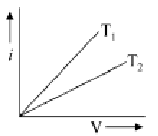
In the given figure, V-i graph of a conductor at two different temperatures is shown. If resistances corresponding to these temperatures are $R_1$ and $R _2$ respectively, then which of the following statement is correct ?
Image