MCQ
Assertion $(A)$ : Electron gain enthalpy becomes less negative as we go down a group.
Reason $(R)$ : Size of the atom increases on going down the group and the added electron would be farther from the nucleus.
  • A
    Assertion and reason both are correct statements but reason is not correct explanation for assertion.
  • Assertion and reason both are correct statements and reason is correct explanation for assertion.
  • C
    Assertion and reason both are wrong statements.
  • D
    Assertion is wrong statement but reason is correct statement.
Answer

Correct option: B.
Assertion and reason both are correct statements and reason is correct explanation for assertion.
On moving down the group, the electron gain enthalpy becomes less negative because on moving down the group the atomic size increases and the added electron lies away from the nucleus.

Need a full question paper?

Generate a complete, print-ready paper with questions like this in minutes — across 16+ boards, with answer keys.

Start Generating Free

Similar questions

Note : In the following questions a statement of Assertion $(A)$ followed by a statement of Reason $(R)$ is given. Choose the correct option out of the choices given\ below each question
Assertion $(A)$ : Increasing order of acidity of hydrogen halides is.
$\ce{HF < HCl < HBr < HI}$
Reason $(R)$ : While comparing acids formed by the elements belonging to the same group of periodic table, $H -$ A bond strength is a more important factor in determining acidity of an acid than the polar nature of the bond.
Assertion (A): Trans-2-butene on reaction with $Br _2$ gives a meso-2,3-dibromobutane.
Reason (R): The reaction involves the syn-addition of bromine.
Notes : In the following questions a statement of Assertion $(A)$ followed by a statement of Reason $(R)$ is given. Choose the correct option out of the Choices given below each question.
Assertion $(A)$ : Combustion of all organic compounds is an exothermic reaction.
Reason $(R)$ : The enthalpies of all elements in their standard state are zero.
Assertion (A): Law of conservation of mass hold good for nuclear reaction.
Reason (R): Law states that mass can be neither created nor destroyed in a chemical reaction.
Assertion (A): The IUPAC name for $CH _3 CH = CH - C \equiv CH$ is pent-3-en-1-yne and not pent-2-en-4-yne.
Reason (R): While deciding the locants for double and triple bonds, lowest sum rule is always followed.
Assertion (A): The standard unit for expressing the mass of atoms is a.m.u.
Reason (R): a.m.u. stands for mass of 1 atom of carbon.
Assertion (A): Atomic mass has no unit but is expressed in amu.
Reason (R): It is the average mass of an atom taking care of the relative abundance of all its possible isotopes.
Direction in the following Questions, the Assertion and Reason have been put forward. Read the statements carefully and choose the correct alternative from the following:
Assertion : $10$ vol $\mathrm{H}_2 \mathrm{O}_2$ gives $10\ ml$ of $\mathrm{O}_2$ at $\text{STP}$
Reason : $10$ vol $\mathrm{H}_2 \mathrm{O}_2$ is $3.03 \%$ and $0.89 M .$
In the following questions a statement of assertion $(A)$ followed by a statement of reason $(R)$ is given. Choose the correct option out of the choices given below each question.
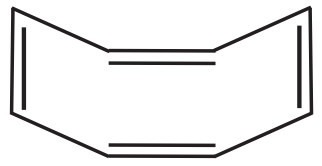
Assertion $(A)$ : The compound cyclooctane has the following structural formula:

It is cyclic and has conjugated $8\pi-$ electron system but it is not an aromatic compound.
Reason $(R) : (4n + 2) \pi-$ electrons rule does not hold good and ring is not planar.
Note : In the following questions a statement of Assertion $(A)$ followed by a statement of Reason $(R)$ is given. Choose the correct option out of the choices given below each question.
Assertion $(A)$ : All isotopes of a given element show the same type of chemical behaviour.
Reason $(R)$ : The chemical properties of an atom are controlled by the number of electrons in the atom.