Question
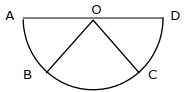
Assertion $A$ : If $A, B, C, D$ are four points on a semi-circular arc with centre at $'O'$ such that $|\overrightarrow{{AB}}|=|\overrightarrow{{BC}}|=|\overrightarrow{{CD}}|$, then $\overrightarrow{{AB}}+\overrightarrow{{AC}}+\overrightarrow{{AD}}=4 \overrightarrow{{AO}}+\overrightarrow{{OB}}+\overrightarrow{{OC}}$

Reason $R$ : Polygon law of vector addition yields $\overrightarrow{A B}+\overrightarrow{B C}+\overrightarrow{C D}+\overrightarrow{A D}=2 \overrightarrow{A O}$

In the light of the above statements, choose the most appropriate answer from the options given below
Answer

$|\overrightarrow{A B}|=|\overrightarrow{B C}|=|\overrightarrow{C D}|$

Here, $O$ is the centre of semi- circle

$\therefore|\overrightarrow{O A}|=|\overrightarrow{O B}|=|\overrightarrow{O C}|=|\overrightarrow{O D}|$

Using vector law of addition, we can write,

$\overrightarrow{ AB }=\overrightarrow{ AO }+\overrightarrow{ OB }$

$\overrightarrow{ AC }=\overrightarrow{ AO }+\overrightarrow{ OC }$

$\overrightarrow{ AD }=\overrightarrow{ AO }+\overrightarrow{ OD }=2 \overrightarrow{ AO }$

After adding all, we get,

$\overrightarrow{A B}+\overrightarrow{A C}+\overrightarrow{A D}=4 \overrightarrow{A O}+\overrightarrow{O B}+\overrightarrow{O C}$

Reason $R$ is the direct result of Polygon law of vector addition

Therefore, Polygon law is applicable in both but the equation given in the reason is not useful in explaining the assertion.

Need a full question paper?

Generate a complete, print-ready paper with questions like this in minutes — across 16+ boards, with answer keys.

Start Generating Free

Similar questions

Two point charges $100\,\mu \,C$ and $5\,\mu \,C$ are placed at points $A$ and $B$ respectively with $AB = 40\,cm$. The work done by external force in displacing the charge $5\,\mu \,C$ from $B$ to $C$, where $BC = 30\,cm$, angle $ABC = \frac{\pi }{2}$ and $\frac{1}{{4\pi {\varepsilon _0}}} = 9 \times {10^9}\,N{m^2}/{C^2}$.........$J$
A red $LED$ emits light at $0.1$ watt uniformly around it. The amplitude of the electric field of the light at a distance of $1\ m$ from the diode is....$ Vm^{-1}$
Starting from rest a body slides down a $45^o$ inclined plane in twice the time it takes to slide down the same distance in the absence of friction. The co-efficient of friction between the body and the inclined plane is: 
If Gravitational constant is decreasing in time, what will remain unchanged in case of a satellite orbiting around earth
For what value of $R$ the net resistance of the circuit will be $18\, ohms$ ............... $\Omega$
Heavy water is
On account of melting of ice at the north pole the moment of inertia of spinning earth
The de-Broglie wavelength of an electron having $80eV$ of energy is nearly .............. $\mathop {\rm{A}}\limits^o $ ($1eV = 1.6 ×10^{-19} J$, Mass of electron $= 9 ×10^{-31} kg$ Plank’s constant $= 6.6 × 10^{-34}$ $J-sec$)
A particle is moving in a straight line with initial velocity and uniform acceleration $a$. If the sum of the distance travelled in $t^{\text {th }}$ and $( t +1)^{ th }$ seconds is $100 cm$, then its velocity after $t$ seconds, in $.........cm / s$, is
If $C$ and $V$ represent capacity and voltage respectively then what are the dimensions of $\lambda,$ where $\frac{ C }{ V }=\lambda ?$