Question
Assertion (A) : If $A=\left(\begin{array}{ccc}l & 0 & 0 \\ 0 & m & 0 \\ 0 & 0 & n\end{array}\right)$, then
$
A^{-1}=\left(\begin{array}{ccc}
1 / l & 0 & 0 \\
0 & 1 / m & 0 \\
0 & 0 & 1 / n
\end{array}\right)
$
Reason $( R )$ : The inverse of a diagonal matrix is a diagonal matrix.
Answer

(b) : $\because A=\left(\begin{array}{ccc}l & 0 & 0 \\ 0 & m & 0 \\ 0 & 0 & n\end{array}\right)$
$\therefore \quad|A|=l m n$ and $\operatorname{adj}(A)=\left(\begin{array}{ccc}m n & 0 & 0 \\ 0 & l n & 0 \\ 0 & 0 & l m\end{array}\right)$
$
\therefore \quad A^{-1}=\frac{\operatorname{adj} A}{|A|}=\left(\begin{array}{ccc}
1 / l & 0 & 0 \\
0 & 1 / m & 0 \\
0 & 0 & 1 / n
\end{array}\right)=\operatorname{diag}\left(\frac{1}{l}, \frac{1}{m}, \frac{1}{n}\right)
$
$\therefore \quad$ Assertion and reason are both correct but reason is not the correct explanation of assertion.

Need a full question paper?

Generate a complete, print-ready paper with questions like this in minutes — across 16+ boards, with answer keys.

Start Generating Free

Similar questions

Assertion $(A) :$ The adjacent sides of a parallelogram are along $\vec{a}=\hat{i}+2 \hat{j}$ and $\vec{b}=2 \hat{i}+\hat{j}$. The angle between the diagonals is $150^{\circ}$.
Reason $(R) :$ Two vectors are perpendicular to each other if their dot product is zero.
Assertion (A): The area bounded by the parabola $y^2=4 a x$ and the line $x=a$ and $x=4 a$ is $\frac{56 a^2}{3}$ sq. units.
Reason (R) : The area bounded by the parabola $y^2=49 x$ and $y=m x$ is $8 a^2 / 3 m^3$ sq. units.
Directions: In the following questions, the Assertions (A) and Reason(s) (R) have been put forward. Read both the statements carefully and choose the correct alternative from the following:
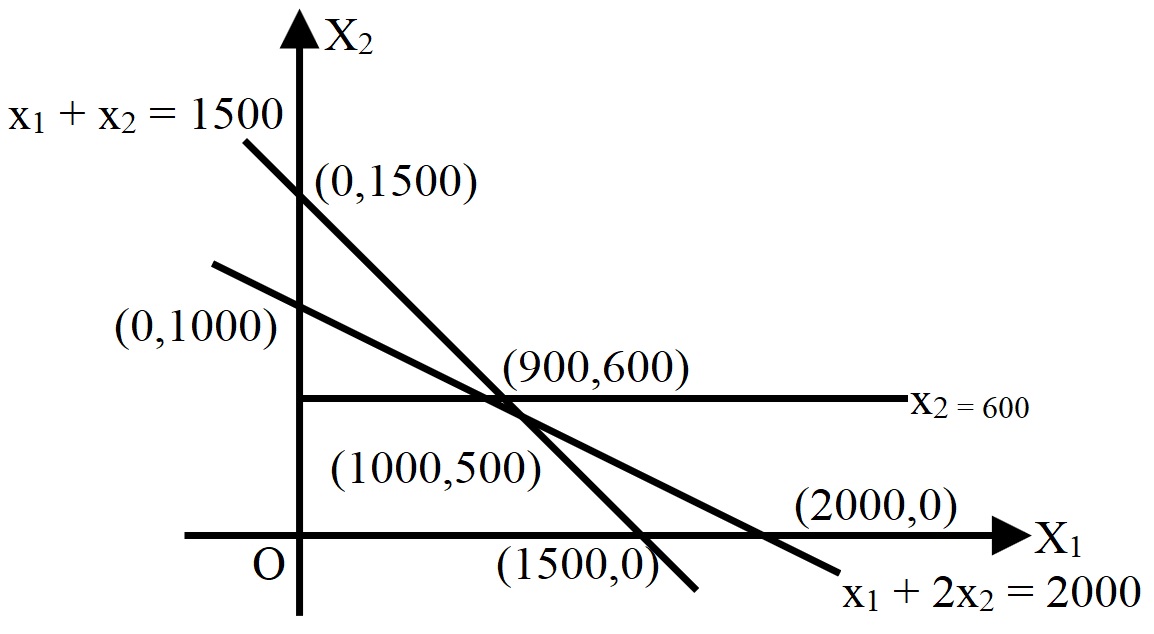
Assertion (A): For the constraints of a LPP problem given by $\text{x}_1+2\text{x}_2\leq2000,\text{x}_1+\text{x}_2\leq1500,\text{x}^2\leq600$ and $\text{x}_1,\text{x}_2\geq0$ the points (1000, 0), (0, 500), (2, 0) lie in the positive bounded region, but point (2000, 0) does not lie in the positive boundedregion.
Reason (R):
  1. Both A and R are true and R is the correct explanation of A
  2. Both A and R are true but R is NOT the correct explanation of A
  3. A is true but R is false.
  4. A is false but R is true.
Directions: In the following questions, a statement of assertion (A) is followed by a statement of reason (R). Mark the correct choice as:
Assertion: A relation R = {(1, 1), (1, 3), (1.5), (3, 1), (3, 3), (3,5} defined on the set A = {1, 3, 5} is transitive.
Reason: A relation R on the set A is symmetric $(\text{a},\text{b})\in\text{R}$ and $(\text{a},\text{c})\in\text{R}$
$\Rightarrow(\text{a},\text{c})\in\text{R}).$
  1. Both A and R are true and R is the correct explanation of A. 
  2. Both A and R are true but R is not the correct explanation of A.
  3. A is true but R is false.
  4. A is false but R is true.
  5. Both A and R are fals.
Assertion (A) : If $f^{\prime}(x)=(x-1)^3(x-2)^8$, then $f(x)$ has neither maximum nor minimum at $x=2$.
Reason $( R ): f^{\prime}(x)$ changes sign from negative to positive at $x=2$.
Directions: In the following questions, a statement of assertion $(A)$ is followed by a statement of reason $(R).$ Mark the correct choice as:
Assertion: Let A and $B$ are $2\times 2$ matrices. $AB = I_2$
$\Rightarrow A = B^{-1}.$
Reason: $AB = 0$
$\Rightarrow A = 0$ or $B = 0.$
Directions: In the following questions, a statement of assertion (A) is followed by a statement of reason (R). Mark the correct choice as:
Assertion: If A is a non singular square matrix of order 3x3 and $\mid\text{A}\mid=5$ then $\mid\text{adj}\text{A}\mid$ is equal to 125.
Reason: $\mid\text{adj}\text{A}\mid=(\mid\text{A}\mid)^{\text{n}-1}$ where n is order of A.
  1. Both A and R are true and R is the correct explanation of A.
  2. Both A and R are true but R is not the correct explanation of A.
  3. A is true but R is false.
  4. A is false but R is true.
  5. Both A and R are false.
Directions: In the following questions, a statement of assertion (A) is followed by a statement of reason (R). Mark the correct choice as:
Assertion: The equation of the line joining (1, 2) and (3, 6) using determinants is y = 3x.
Reason: The area of $\triangle\text{PAB}$ is zero if P(x, y) is a point on the line joining a A and B.
  1. Both A and R are true and R is the correct explanation of A.
  2. Both A and R are true but R is not the correct explanation of A.
  3. A is true but R is false.
  4. A is false but R is true.
  5. Both A and R are false.
Assertion $(A)$ : The vectors :
$\vec{a}=6 \hat{i}+2 \hat{j}-8 \hat{k}, \vec{b}=10 \hat{i}-2 \hat{j}-6 \hat{k}, \vec{c}=4 \hat{i}-4 \hat{j}+2 \hat{k}$
represent the sides of a right angled triangle.
Reason $(R)$ : Three non-zero vectors of which none of two are collinear forms a triangle if their resultant is zero vector or sum of any two vectors is equal to the third.
Assertion $(A) : x \sin x \frac{d y}{d x}+(x+x \cos x+\sin x)$ $y=\sin x, y\left(\frac{\pi}{2}\right)=1-\frac{2}{\pi} \Rightarrow y=\frac{x-\sin x}{x(1-\cos x)}$
Reason $(R) :$ The differential equation is linear with integrating factor $x(1-\cos x)$.