Assertion $(A):$ In a meter bridge experiment, null point for an unknown resistance is put inside an enclosure maintained at a higher temperature. The null point can be obtained at the same $p$ as before by decreasing the value of the standard resistance.
Reason $(R):$ Resistance of metal increases with increase in temperature.
AIIMS 2015, Medium


Download our appand get started for free
Experience the future of education. Simply download our apps or reach out to us for more information. Let's shape the future of learning together!No signup needed.*
Similar Questions
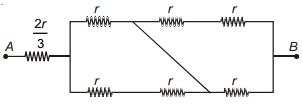
- 1The effective resistance of the network between points $A$ and $B$ isView Solution
- 2In a potentiometer arrangement, a cell of emf $1.20\, V$ gives a balance point at $36\, cm$ length of wire. This cell is now replaced by another cell of emf $1.80\, V$. The difference in balancing length of potentiometer wire in above conditions will be $....cm$.View Solution
- 3When a resistor of $11 \,\Omega$ is connected in series with an electric cell, the current flowing in it is $0.5\, A$. Instead, when a resistor of $5 \,\Omega$ is connected to the same electric cell in series, the current increases by $0.4\, A$. The internal resistance of the cell is ................ $\Omega$View Solution
- 4A strip of copper and another of germanium are cooled from room temperature to $80\, K$. The resistance ofView Solution
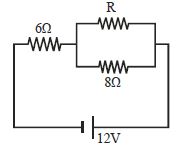
- 5In the circuit shown in figure, the power which is dissipated as heat in the $6\,\Omega $ resistor is $6\,W$. What is the value of resistance $R$ in the circuit? ................ $\Omega$View Solution
- 6Two resistors are connected $(a)$ in series $(b)$ in parallel. The equivalent resistance in the two cases are $9$ $ohm$ and $2$ $ohm$ respectively. Then the resistances of the component resistors areView Solution
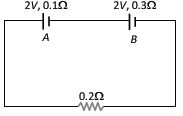
- 7The internal resistances of two cells shown are $0.1\,\Omega $ and $0.3\,\Omega $. If $R = 0.2\,\Omega $, the potential difference across the cellView Solution
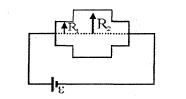
- 8A cylindrical resistance is connected across battery $\varepsilon $ . Cylinder has uniform free electron density, mid part of cylinder has larger radius as shown in figure. Then $V_d$ (drift velocity) $V/S$ (distance across the length of the resistance)View Solution
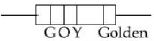
- 9View SolutionA carbon resistance has a following colour code. What is the value of the resistance?
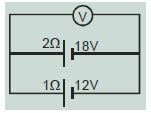
- 10Two batteries, one of $emf$ $18\, volts$ and internal resistance $2\,\Omega $ and the other of $emf$ $12\, volt$ and internal resistance $1\,\Omega $, are connected as shown. The voltmeter $V$ will record a reading of .............. $\mathrm{volt}$View Solution