MCQ
Assertion (A): Let $f(x)=x^3+a x^2+b x+5 \sin ^2 x$, then the condition that $f(x)$ is always one-one function is $a^2-3 b+15<0$.
Reason (R) : $f(x)$ to be one one either $f$ is strictly increasing or strictly decreasing.
  • A
    Both (A) and (R) are true and (R) is the correct explanation of (A).
  • B
    Both (A) and (R) are true but (R) is not the correct explanation of (A).
  • C
    (A) is true but (R) is false.
  • D
    (A) is false but (R) is true.

Answer

$
\begin{array}{l}
\text { (a): } f(x)=x^3+a x^2+b x+5 \sin ^2 x \\
\therefore \quad f^{\prime}(x)=3 x^2+2 a x+b+5 \sin 2 x
\end{array}
$
For one-one function, $f^{\prime}(x)>0$ for $x \in R$
$
\begin{array}{l}
\Rightarrow \quad 3 x^2+2 a x+b+5 \sin 2 x>0 \\
\Rightarrow \quad 3 x^2+2 a x+(b-5)>0 \Rightarrow(2 a)^2-4 \cdot 3(b-5)<0 \\
\Rightarrow \quad a^2-3 b+15<0
\end{array}
$

Need a full question paper?

Generate a complete, print-ready paper with questions like this in minutes — across 16+ boards, with answer keys.

Start Generating Free

Similar questions

Directions: In the following questions, a statement of assertion (A) is followed by a statement of reason (R). Mark the correct choice as:
Assertion: Domain and Range of a relation R = {{x, y) : x -2y = 0} defined on the set A = {1, 2, 3, 4} are respectively {1, 2, 3, 4} and {2, 4, 6, 8}.
Reason: Domain and Range of a relation R are respectively the sets {$\text{a}:\text{a}\in\text{A}$ and $(\text{a},\text{b})\in\text{R}.$} and {$\text{b}:\text{b}\in\text{A}$ and $(\text{a},\text{b})\in\text{R}.$}
  1. Both A and R are true and R is the correct explanation of A.
  2. Both A and R are true but R is not the correct explanation of A.
  3. A is true but R is false.
  4. A is false but R is true.
  5. Both A and R are fals.
Directions: In the following questions, the Assertions (A) and Reason(s) (R) have been put forward. Read both the statements carefully and choose the correct alternative from the following:
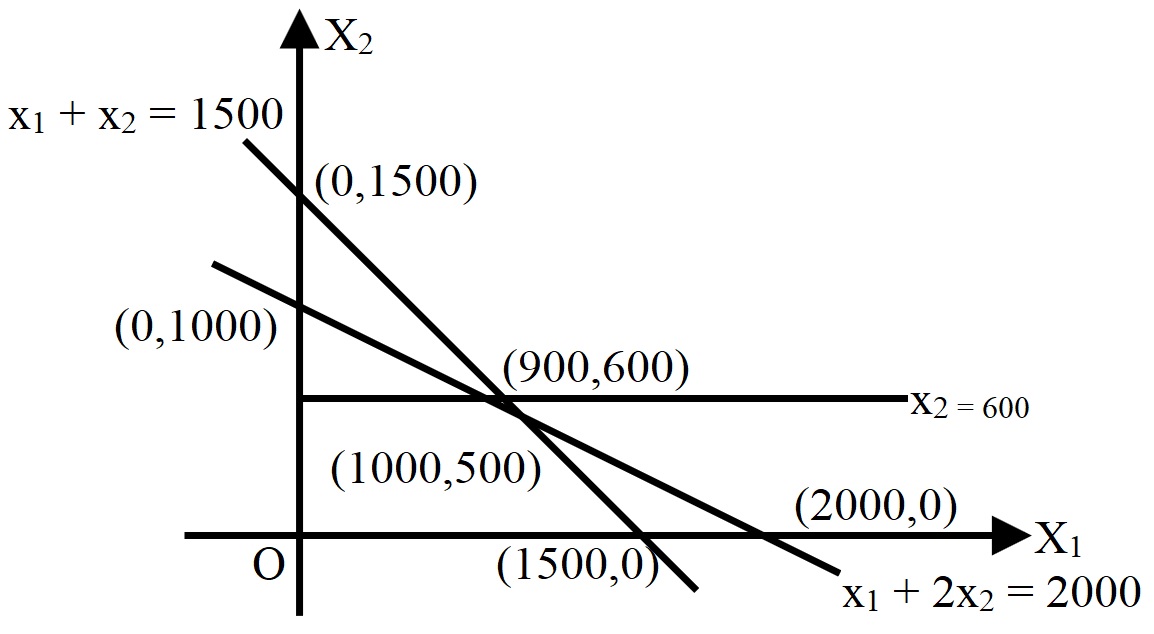
Assertion (A): For the constraints of a LPP problem given by $\text{x}_1+2\text{x}_2\leq2000,\text{x}_1+\text{x}_2\leq1500,\text{x}^2\leq600$ and $\text{x}_1,\text{x}_2\geq0$ the points (1000, 0), (0, 500), (2, 0) lie in the positive bounded region, but point (2000, 0) does not lie in the positive boundedregion.
Reason (R):

  1. Both A and R are true and R is the correct explanation of A
  2. Both A and R are true but R is NOT the correct explanation of A
  3. A is true but R is false.
  4. A is false but R is true.
Directions: In these questions, a statement of Assertion is followed by a statement of Reason is given.Choose the correct answer out of the following choices:
Assertion: The area bounded by the curves $\text{y}^2 = 4\text{a}^2(\text{x} — 1) $ and lines $\text{x}=1$ and $\text{y}=4$ a is $\frac{8\text{a}}{3}\text{sq.units}$
Reason: The area enclosed between the parabola $\text{y}=\text{x}^2-\text{x}+2$ and the line $\text{y}=\text{x+2}$ is $\frac{4}{3}\text{ sq.units}$
  1. Assertion and Reason both are correct statements and Reason is the correct explanation of Assertion.
  2. Assertion and Reason both are correct statements but Reason is not the correct explanation of Assertion.
  3. Assertion is correct statement but Reason is wrong statement.
  4. Assertion is wrong statement but Reason is correct statement.
Directions: In the following questions, the Assertions (A) and Reason(s) (R) have been put forward. Read both the statements carefully and choose the correct alternative from the following:
Assertion: In $\triangle\text{ABC},\overrightarrow{\text{AB}}+\overrightarrow{\text{BC}}+\overrightarrow{\text{CA}}=0.$
Reason: If $\overrightarrow{\text{OA}}=\overrightarrow{\text{a}},\overrightarrow{\text{OB}},\overrightarrow{\text{b}},$ then $\overrightarrow{\text{AB}}=\overrightarrow{\text{a}}+\overrightarrow{\text{b}}.$
  1. Both Assertion and Reason are correct and Reason is the correct explanation for Assertion.
  2. Both Assertion and Reason are correct but Reason is not the correct explanation for Assertion.
  3. Assertion is correct but Reason is incorrect.
  4. Both Assertion and Reason are incorrect.
Directions: In these questions, a statement of Assertion is followed by a statement of Reason is given.Choose the correct answer out of the following choices:
Assertion: $\int\sin3\text{x}\cos5\text{x}\text{ dx}=\frac{-\cos8\text{x}}{16}+\frac{\cos2\text{x}}{4}+\text{C}$
Reason: $2\cos\text{A}\sin\text{B}=\sin(\text{A+B})-\sin(\text{A-B})$
  1. Assertion and Reason both are correct statements and Reason is the correct explanation of Assertion.
  2. Assertion and Reason both are correct statements but Reason is not the correct explanation of Assertion.
  3. Assertion is correct statement but Reason is wrong statement.
  4. Assertion is wrong statement but Reason is correct statement.
Assertion (A) : The probability that candidates $A$ and $B$ can solve the problem is $\frac{1}{5}$ and $\frac{2}{5}$, then probability that problem will be solved is given by $\frac{12}{25}$.
Reason (R): If events $A \& B$ are independent, then $P(A \cap B)=P(A) \times P(B)$.
Assertion (A): The relation $R=\{(x, y):(x+y)$ is a prime number and $x, y \in N\}$ is not a reflexive relation.
Reason (R) : The number ' $2 n$ ' is composite for all natural numbers $n$.
Directions: In the following questions, a statement of assertion (A) is followed by a statement of reason (R). Mark the correct choice as:
Assertion: Value of x for which the matrix $\begin{bmatrix}1&2&0\\0&1&2\\-1&2&\text{x}\end{bmatrix}$ is singular is 5.
Reason: A square matrix is singular if $\mid\text{A}\mid=0.$
  1. Both A and R are true and R is the correct explanation of A.
  2. Both A and R are true but R is not the correct explanation of A.
  3. A is true but R is false.
  4. A is false but R is true.
  5. Both A and R are false.
Directions: In the following questions, a statement of assertion (A) is followed by a statement of reason (R). Mark the correct choice as:
Assertion: If $\text{A}=\begin{pmatrix}3&-2&10\\-2&4&5\\10&5&6\end{pmatrix}$ and $\text{x}=\begin{pmatrix}1&5&6\\-2&0&1\\4&3&2\end{pmatrix}$ X'AX is symmetric matrix.
Reason:  X'AX is symmetric or skew symmetric as A is symmetric or skew symmetric.
  1. Both A and R are true and R is the correct explanation of A.
  2. Both A and R are true but R is not the correct explanation of A.
  3. A is true but R is false.
  4. A is false but R is true.
  5. Both A and R are false.
Directions: In the following questions, a statement of assertion (A) is followed by a statement of reason (R). Mark the correct choice as:
Assertion: Value of x for which the matrix $\begin{bmatrix}1&2&0\\0&1&2\\-1&2&\text{x}\end{bmatrix}$ is singular is 5.
Reason: A square matrix is singular if $\mid\text{A}\mid=0.$
  1. Both A and R are true and R is the correct explanation of A.
  2. Both A and R are true but R is not the correct explanation of A.
  3. A is true but R is false.
  4. A is false but R is true.
  5. Both A and R are false.