MCQ
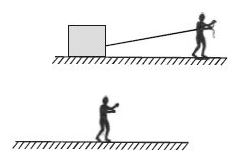
$Assertion$ : A man and a block rest on smooth horizontal surface. The man holds a rope which is connected to block. The man cannot move on the horizontal surface

$Reason$ : A man standing at rest on smooth horizontal surface cannot start walking due to absence of friction (The man is only in contact with floor as shown).
  • A
    If both Assertion and Reason are correct and the Reason is a correct explanation of the Assertion.
  • B
    If both Assertion and Reason are correct but Reason is not a correct explanation of the Assertion.
  • C
    If the Assertion is correct but Reason is incorrect.
  • If both the Assertion and Reason are incorrect.
Answer

Correct option: D.
If both the Assertion and Reason are incorrect.
d
The man can exert force on block by pulling the rope. The tension in rope will make the man move. Hence Assertion is incorrect.

Need a full question paper?

Generate a complete, print-ready paper with questions like this in minutes — across 16+ boards, with answer keys.

Start Generating Free

Similar questions

An ideal fluid flows (laminar flow) through a pipe of non-uniform diameter. The maximum and minimum diameters of the pipes are $6.4 \;\mathrm{cm}$ and $4.8 \;\mathrm{cm},$ respectively. The ratio of the minimum and the maximum velocities of fluid in this pipe is:
A metal block is resting on a rough wooden surface. A horizontal force applied to the block is increased uniformly. Which of the following curves correctly represents velocity of the block ?
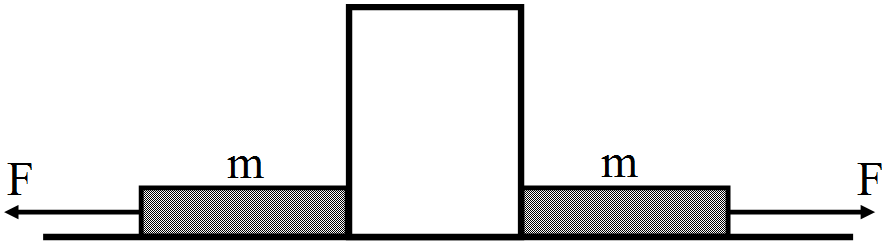
Figure shows a heavy block kept on a frictionless surface and being pulled by two ropes of equal mass $m.$ At $t = 0$, the force on the left rope is withdrawn but the
force on the right end continues to act. Let $F_1$ and $F_2$ be the magnitudes of the forces by the right rope and the left rope on the block respectively:
A body old $2\ kg$ has an initial speed $5\ ms^{-1}$ . A force acts on it for some time in the direction of motion. The force time graph is shown in figure. The final speed of the body .......... $ms^{-1}$
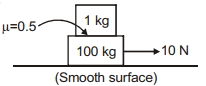
The frictional force acting on $1 \,kg$ block is .................. $N$
A particle moves along an arc of a circle of radius $R$ . Its velocity depends on the distance covered as $v = a\sqrt s$ , where $a$ is a constant then the angle $\alpha $ between the vector of the total acceleration and the vector of velocity as a function of $s$ will be
A particle of mass $M\ kg$ describes a circle of radius $1m$. The centripetal acceleration of the particle is $4\ m/ s^2.$ What will be the momentum of the particle ?
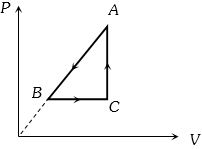
$P-V$ diagram of a cyclic process $ABCA$ is as shown in figure. Choose the correct statement
When two sound waves with a phase difference of $\pi /2$, and each having amplitude $A$ and frequency $\omega $, are superimposed on each other, then the maximum amplitude and frequency of resultant wave is
If the overbridge is concave instead of being convex, the thrust on the road at the lowest position will be