Question

Assertion  :  A narrow pulse of light is sent through a medium. The pulse will  retain its shape as it travels through the medium.

Reason      : A narrow pulse is made of harmonic waves with a large range of wavelengths.

(a) If both assertion and reason are true and the reason is the correct explanation of the assertion.

(b) If both assertion and reason are true but reason is not the correct explanation of the assertion.

(c) If assertion is true but reason is false.

(d) If assertion is false but reason is true.

Answer

(d) If assertion is false but reason is true.

Need a full question paper?

Generate a complete, print-ready paper with questions like this in minutes — across 16+ boards, with answer keys.

Start Generating Free

Similar questions

The  electric charge in uniform motion produces

(a) An electric field only

(b) A magnetic field only

(c) Both electric and magnetic field

(d) Neither electric nor magnetic field

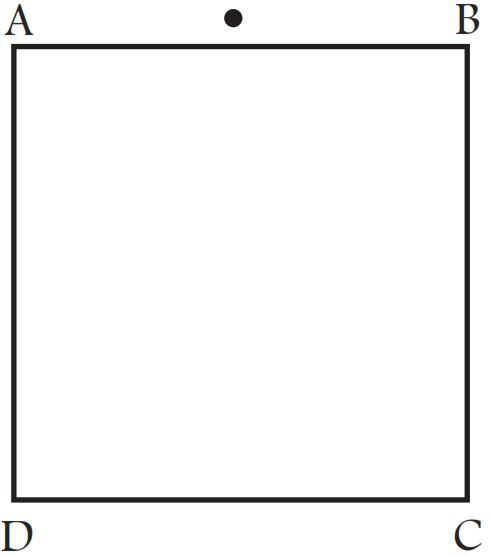
A rectangular block of glass ABCD has a refractive index 1.6. A pin is placed midway on the face AB (Fig). When observed from the face AD, the pin shall:

In image formation from spherical mirrors, only paraxial rays are considered because they:
  1. Are easy to handle geometrically.
  2. Contain most of the intensity of the incident light.
  3. Form nearly a point image of a point source.
  4. Show minimum dispersion effect.
When an electron moves through a magnetic field, its speed will:

Two plane mirrors. A and B are aligned parallel to each other, as shown in the figure. A light ray is incident at an angle of 30°  at a point just inside one end of A. The plane of incidence coincides with the plane of the figure. The maximum number of times the ray undergoes reflections (including the first one) before it emerges out is

(a) 28

(b) 30

(c) 32

(d) 34

When a ferromagnetic material goes through a hysteresis loop, the magnetic susceptibility:
  1. Has a fixed value.
  2. May be zero.
  3. May be infinity.
  4. May be negative.

The galaxies are moving away from each other. It is explained by

(a) White dwarf star

(b) Red shift

(c) Neutron star

(d) None of these

The de-Broglie wavelength is proportional to

(a) λ  

(b) λ

(c) λ  

(d) λ p

In the circuit shown below E1 = 4.0 V, R1 = 2 W, E2 =  6.0 V, R2 = 4 W and R3 = 2 W.  The current  I1 is

(a) 1.6 A

(b) 1.8 A

(c) 1.25 A   

(d) 1.0 A

A man cannot see clearly the objects beyond a distance of 20 cm from his eyes. To see distant objects clearly he must use which kind of lenses and of what focal length

(a) 100 cm convex

(b) 100 cm concave

(c) 20 cm convex

(d) 20 cm concave