MCQ
Assertion (A): The linear equation in one variable x, is $\frac{\text{x}}{2}+\frac{\text{x}}{3}+\frac{1}{4}$
Reason (R): Standard form for linear equation in one variable is ax + b = 0. where x is variable and a, b are arbitrary constants.
  • Both A and R are true and R is the correct explanation of A
  • B
    Both A and R are true but R is not the correct explanation of A
  • C
    A is true but R is false
  • D
    A is false but R is true

Answer

Correct option: A.
Both A and R are true and R is the correct explanation of A
A

Need a full question paper?

Generate a complete, print-ready paper with questions like this in minutes — across 16+ boards, with answer keys.

Start Generating Free

Similar questions

Assertion (A): $8^{-2}$ is the same as $2^{-8}$.
Reason (R): If $\frac{a}{b}$ be a rational number and $n$ be a positive integer then $\left(\frac{a}{b}\right)^{-n}=\left(\frac{b}{a}\right)^n$.
Directions : In the following questions, the Assertions $(A)$ and Reason $(s)\ (R)$ have been put forward. Read both the statements carefully and choose the correct alternative from the following:
Assertion $(A) :$ Rational numbers are commutative for multiplication
Reason $(R) :$ Rational numbers are commutative under addition and multiplication
Assertion (A): a × (b × c) = (a × b) × c is called associative law for multiplication
Reason (R): The associative laws state that when you add or multiply any three real numbers, the grouping (or association) of the numbers does not affect the result.
Directions: In the following questions, the Assertions $(A)$ and Reason$(s) (R)$ have been put forward. Read both the statements carefully and choose the correct alternative from the following:
Assertion $(A):$ Natural numbers are associative for division
Reason $(R):$ The associative property states that the sum or the product of three or more numbers does not change if they are grouped in a different way.
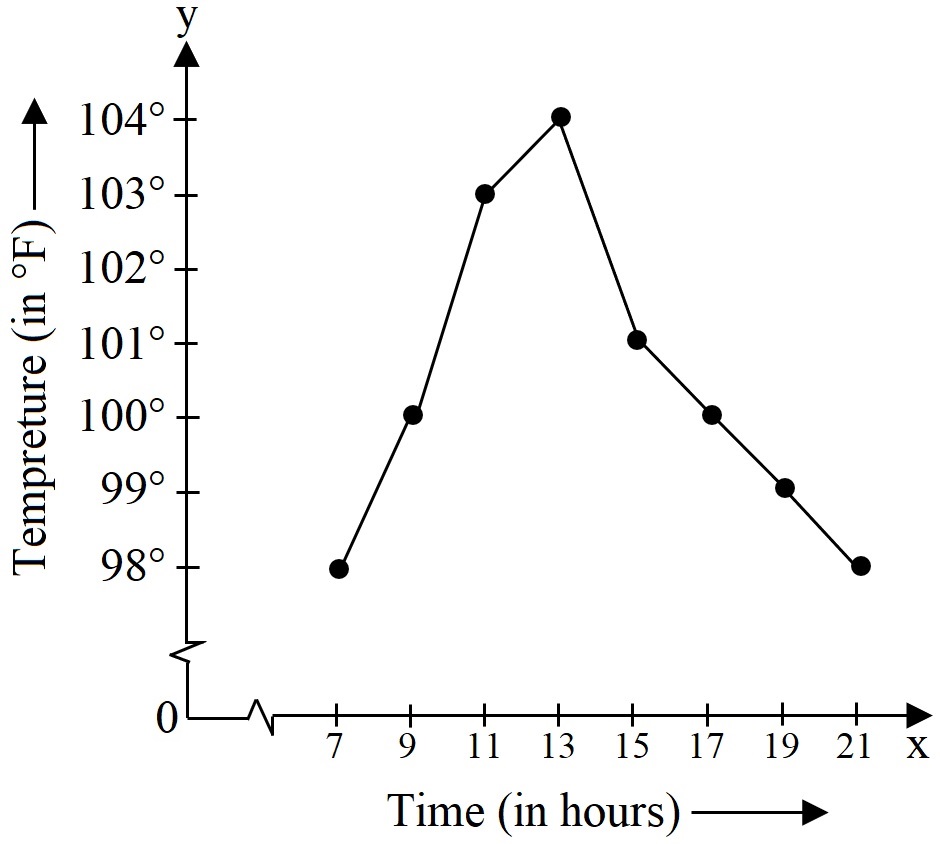
Directions: In the following questions, the Assertions $(A)$ and Reason(s) $(R)$ have been put forward. Read both the statements carefully and choose the correct alternative from the following: Observe the following temperature time graph and consider it as reasons for the following assertions:

Assertion (A): The fall in temperature from $13$ hours to $21$ hours is $6^\circ F$
Directions: In the following questions, the Assertions $(A)$ and Reason(s) $(R)$ have been put forward. Read both the statements carefully and choose the correct alternative from the following:
Assertion (A): The root of the equation $\frac{7\text{x}}{3} = {3}$ is $\frac{5\text{x}}{3}$
Reason (R): The value of the variable which makes left hand side equal to right hand side in the given equation is called the solution or the root of the equation
Directions: In the following questions, the Assertions $(A)$ and Reason(s) $(R)$ have been put forward. Read both the statements carefully and choose the correct alternative from the following:
Assertion (A): The common factor of $p^3 q^4$ and $p^4 q^3$ is $p^3 q^3$
Reasons (R): A common factor is a number that can be divided into two different numbers, without leaving a remainder.
Assertion (A) The square root of a perfect square is always a whole number.
Reason (R) A perfect square is a number that can be expressed as the product of an integer by itself.
(e.g. $9=3 \times 3$ or $16=4 \times 4$)
Assertion (A): Natural numbers are commutative for subtraction
Reason (R): Rational numbers are commutative under addition and multiplication
Assertion (A): A labourer is paid Rs 400 for 2 days work. Then if he works for 5 days he will get Rs 1100.
Reasons (R): A direct proportion shows the direct the relation between two quantities. An inverse proportion shows inverse or indirect relation between two quantities.