Question
Assertion (A): The matrix $A=\left(\begin{array}{ccc}0 & a & b \\ -a & 0 & c \\ -b & -c & 0\end{array}\right)$ is a skew-symmetric matrix.
Reason (R) : A square matrix $A=\left(a_{i j}\right)$ of order $m$ is said to be skew-symmetric if $A^T=-A$.
Answer

(a) : $A=\left(\begin{array}{ccc}0 & a & b \\ -a & 0 & c \\ -b & -c & 0\end{array}\right) \therefore A^T=\left(\begin{array}{ccc}0 & -a & -b \\ a & 0 & -c \\ b & c & 0\end{array}\right)$
$
\Rightarrow \quad A^T=-A
$
$\therefore \quad$ Assertion and Reason both are true and Reason is correct explanation of Assertion.

Need a full question paper?

Generate a complete, print-ready paper with questions like this in minutes — across 16+ boards, with answer keys.

Start Generating Free

Similar questions

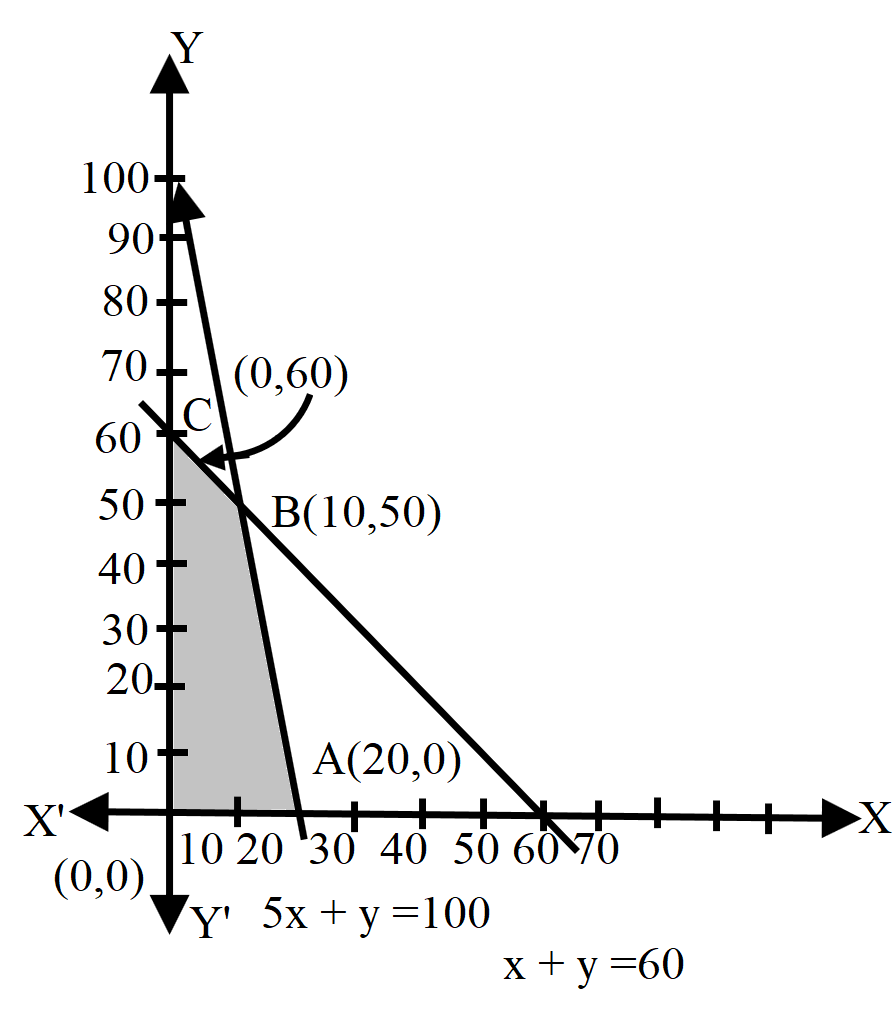
Directions: In the following questions, the Assertions (A) and Reason(s) (R) have been put forward. Read both the statements carefully and choose the correct alternative from the following: Consider, the graph of constraints stated as linear inequalities as below: $5\text{x}+\text{y}\leq100,\text{x}+\text{y}\leq60,\text{x},\text{y}\geq0.$
Assertion (A): (25, 40) is an infeasible solution of the problem. Reason (R): Any point inside the feasible region is called an infeasible solution.
  1. Both A and R are true and R is the correct explanation of A
  2. Both A and R are true but R is NOT the correct explanation of A
  3. A is true but R is false.
  4. A is false but R is true.
Assertion (A) : The relation $R$ in a set
$A=\{1,2,3,4\}$ defined by $R=\{(x, y): 3 x-y=0\}$
have the Domain $=\{1,2,3,4\}$ and Range $=$ $\{3,6,9,12\}$.
Reason (R) : Domain & Range of the relation $(R)$ is respectively the set of all first & second entries of the distinct ordered pair of the relation.
Directions: In the following questions, a statement of assertion (A) is followed by a statement of reason (R). Mark the correct choice as:
Assertion: Value of x for which the matrix $\begin{bmatrix}1&2&0\\0&1&2\\-1&2&\text{x}\end{bmatrix}$ is singular is 5.
Reason: A square matrix is singular if $\mid\text{A}\mid=0.$
  1. Both A and R are true and R is the correct explanation of A.
  2. Both A and R are true but R is not the correct explanation of A.
  3. A is true but R is false.
  4. A is false but R is true.
  5. Both A and R are false.
Assertion (A): The rate of change of area of a circle with respect to its radius $r$ when $r=6 cm$ is $12 \pi cm^2 / cm$.
Reason (R): Rate of change of area of a circle with respect to its radius r is $\frac{d A}{d r}$, where A is the area of the circle.
Assertion $(A) : x \sin x \frac{d y}{d x}+(x+x \cos x+\sin x)$ $y=\sin x, y\left(\frac{\pi}{2}\right)=1-\frac{2}{\pi} \Rightarrow y=\frac{x-\sin x}{x(1-\cos x)}$
Reason $(R) :$ The differential equation is linear with integrating factor $x(1-\cos x)$.
Assertion (A): Domain of $y=\cos ^{-1}(x)$ is $[-1,1]$.
Reason $(R)$ : The range of the principal value branch of $y=\cos ^{-1}(x)$ is $[0, \pi]-\left\{\frac{\pi}{2}\right\}$.
Directions: In the following questions, a statement of assertion (A) is followed by a statement of reason (R). Mark the correct choice as:
Assertion: If n(A) = m, then the number of reflexive relations on A is m.
Reason: A relation R on the set A is reflexive if $(\text{a},\text{a})\in\text{R},$ $\forall\ \text{a}\in\text{A}.$
  1. Both A and R are true and R is the correct explanation of A.
  2. Both A and R are true but R is not the correct explanation of A.
  3. A is true but R is false.
  4. A is false but R is true.
  5. Both A and R are fals.
Assertion (A) : An urn contains 5 red and 5 black balls. A ball is drawn at random, its colour is noted and is returned to the urn. Moreover, 2 additional balls of the colour drawn are put in the urn and then a ball is drawn at random. Then, the probability that the second ball is red is $\frac{1}{2}$.
Reason (R) : By Bayes' Theorem
$
\begin{array}{r}
P\left(E_1 \mid E\right)=\frac{P\left(E \mid E_1\right) P\left(E_1\right)}{P\left(E_1\right) P\left(E \mid E_1\right)+P\left(E_2\right) P\left(E \mid E_2\right)+P\left(E_3\right) P\left(E \mid E_3\right)}
\end{array}
$
Assertion $(A) :$ The probability that candidates $A$ and $B$ can solve the problem is $\frac{1}{5}$ and $\frac{2}{5}$, then probability that problem will be solved is given by $\frac{12}{25}$.
Reason $(R):$ If events $A \& B$ are independent, then $P(A \cap B)=P(A) \times P(B)$.
Directions: In the following questions, a statement of assertion (A) is followed by a statement of reason (R). Mark the correct choice as:
Assertion: Let $\text{A}_{\theta}=\begin{pmatrix}\cos\theta+\sin\theta&\sqrt{2}\sin\theta\\-\sqrt{2}\sin\theta&\cos\theta-\sin\theta\end{pmatrix}\Big(\text{A}_{\frac{\pi}{3}}\Big)^{3}=-\text{I}.$ 
Reason: $\text{A}_{\theta}\cdot\text{A}_{\phi}=\text{A}_{\theta+\phi}.$
  1. Both A and R are true and R is the correct explanation of A.
  2. Both A and R are true but R is not the correct explanation of A.
  3. A is true but R is false.
  4. A is false but R is true.
  5. Both A and R are false.