MCQ
Assertion : Acetaldehyde on treatment with alkali gives aldol.
Reason : Acetaldehyde molecule contains $\alpha  - $ hydrogen atom
  • If both Assertion and Reason are correct and the Reason is a correct explanation of the Assertion.
  • B
    If both Assertion and Reason are correct but Reason is not a correct explanation of the Assertion.
  • C
    If the Assertion is correct but Reason is incorrect.
  • D
    If both the Assertion and Reason are incorrect.
Answer

Correct option: A.
If both Assertion and Reason are correct and the Reason is a correct explanation of the Assertion.
a
Acetaldehyde gives aldol condensation reaction because it contains $\alpha  - $ ydrogen

Need a full question paper?

Generate a complete, print-ready paper with questions like this in minutes — across 16+ boards, with answer keys.

Start Generating Free

Similar questions

The no. of moles of electrons required to deposit $1\, g$ equivalent of aluminium $(At.\, wt. = 27)$ from a solution of aluminium chloride will be
For any reaction, if we plot a graph between time '$t$' and $\log (a - x)$, a simple line is obtained. The order of reaction is
A solution of polystyrene in benzene contains $10\,g/L$ the equilibrium height of the column of solution having density $0.9\,g/ml$ in the osmometer having capillary rise $11\,cm$ at $27\,^oC$ what is average molar mass of polystyrene (Assume solution is ideal)
Which one of the following will go decarboxylation on heating?
The order of stability of the following tautomeric compounds is

$\mathop {\begin{array}{*{20}{c}}
  {OH\,\,\,\,\,\,\,\,\,\,\,\,\,\,\,\,\,\,\,\,\,\,\,O} \\ 
  {|\,\,\,\,\,\,\,\,\,\,\,\,\,\,\,\,\,\,\,\,\,\,\,\,\,\,\,\,||} \\ 
  {C{H_2} = C - C{H_2} - C - C{H_3}} 
\end{array}}\limits_{(I)}  \rightleftharpoons $

$\mathop {\begin{array}{*{20}{c}}
  {OH\,\,\,\,\,\,\,\,\,\,\,\,\,\,\,\,\,\,\,O} \\ 
  {|\,\,\,\,\,\,\,\,\,\,\,\,\,\,\,\,\,\,\,\,\,\,\,\,\,||} \\ 
  {C{H_3} - C - C{H_2} - C - C{H_3}} 
\end{array}}\limits_{(II)}  \rightleftharpoons $

$\mathop {\begin{array}{*{20}{c}}
  {OH\,\,\,\,\,\,\,\,\,\,\,\,\,\,\,\,\,\,\,O} \\ 
  {|\,\,\,\,\,\,\,\,\,\,\,\,\,\,\,\,\,\,\,\,\,\,\,\,\,||} \\ 
  {C{H_3} - C = CH - C - C{H_3}} 
\end{array}}\limits_{(III)} $

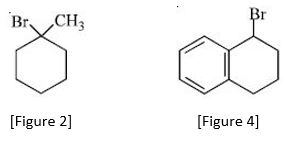
Consider the $S_N1$ solvolysis of the following halides in aqueous formic acid :

$(I)$ $\begin{array}{*{20}{c}}  {C{H_3}\,\,\,\,\,\,Br} \\   {|\,\,\,\,\,\,\,\,\,\,\,\,\,\,\,\,|\,\,} \\   {C{H_3} - CH - CH - C{H_3}} \end{array}$

$(II)$ $[Figure\,2]$

$(III)$ $\begin{array}{*{20}{c}}  {{C_6}{H_5} - CH - {C_6}{H_5}} \\   {|\,\,\,} \\   {Br} \end{array}$ 

$(IV)$ $[Figure\,4]$

Which one of the following is correct sequence of the halides given above in the decreasing order of their reactivity ?

Given below are two statements :

Statement $I :$ The limiting molar conductivity of $\mathrm{KCl}$ (strong electrolyte) is higher compared to that of $\mathrm{CH}_{3} \mathrm{COOH}$ (weak electrolyte).

Statement $II :$ Molar conductivity decreases with decrease in concentration of electrolyte.

In the light of the above statements, choose the most appropriate answer from the options given below:

Velocity constant $K$ of a reaction is affected by
When benzyl chloride is treated with ethanolic $KCN$, the major product formed is
Which of the following is not a sex hormone