MCQ
Assertion : Benzaldehyde is more reactive than ethanol towards nucleophilic attack.
Reason : The overall effect of $-I$ and $+ R$ effect of phenyl group decreases the electron density on the carbon atom of $> C = O$ group in benzaldehyde
  • A
    If both Assertion and Reason are correct and the Reason is a correct explanation of the Assertion.
  • B
    If both Assertion and Reason are correct but Reason is not a correct explanation of the Assertion.
  • C
    If the Assertion is correct but Reason is incorrect.
  • If both the Assertion and Reason are incorrect.
Answer

Correct option: D.
If both the Assertion and Reason are incorrect.
d
Benzaldehyde is less reactive than ethanol towards nucleophilic attack. The combined effect of $-I$ and $+R$ effect of phenyl group is electron donating which increases the electron density on the carbon atom of the $> C = O$ in benzaldehyde.

Need a full question paper?

Generate a complete, print-ready paper with questions like this in minutes — across 16+ boards, with answer keys.

Start Generating Free

Similar questions

Which of the following properties of pure metal makes it more useful then the corresponding alloy
Match List$-I$ with List$-II$:

List$-I$

(Parameter)

List$-II$

(Unit)

$(a)$ Cell constant $(i)$ $\mathrm{S}\, \mathrm{cm}^{2} \,\mathrm{~mol}^{-1}$
$(b)$ Molar conductivity $(ii)$ Dimensionless
$(c)$ Conductivity $(iii)$ $\mathrm{m}^{-1}$
$(d)$ Degree of dissociation of electrolyte $(iv)$ $\Omega^{-1} \,\mathrm{~m}^{-1}$

Choose the most appropriate answer from the options given below :

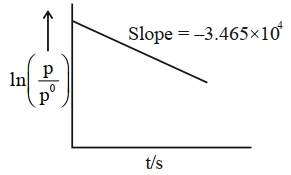
For the decomposition of azomethane. $CH _{3} N _{2} CH _{3}( g ) \rightarrow CH _{3} CH _{3}( g )+ N _{2}$ (g) a first order reaction, the variation in partial pressure with time at $600\,K$ is given as
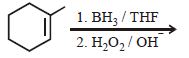
Product of reaction is 
Select the final product from this sequence of reactions. 

Acetoacetic ester $\xrightarrow{NaOEt}$  $\xrightarrow{C{{H}_{3}}I}$  $\xrightarrow{NaOEt}$   $\xrightarrow{C{{H}_{3}}C{{H}_{2}}C{{H}_{2}}Br}$

Molybdenum compounds are used in
The $pH $ at which maximum hydrate is present in an solution of oxaloacetic acid

$\begin{align}
   \begin{matrix}
   \,\,\,\,\,\,\,\,\,\,\,\,\,\,\,\,\,\,\,O\,\,\,\,\,\,\,O  \\
   \,\,\,\,\,\,\,\,\,\,\,\,\,\,\,\,\,\,\,||\,\,\,\,\,\,\,\,\,||  \\
   H-O-C-C-  \\
\end{matrix}\begin{matrix}
   O\,\,  \\
   ||\,\,\,  \\
   C{{H}_{2}}-C-O-H  \\
\end{matrix} \\ 
  p{{K}_{a}}=2.2\,\,\,\,\,\,\,\,\,\,\,\,\,\,\,\,p{{K}_{a}}=3.98 \\ 
\end{align}$

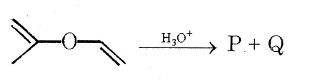
In above sequence $'P'$ and $'Q'$ products can be distinguished by ?
Match the complexes in Column-$I$ with their properties listed in Column-$II$. Indicate your answer by darkening the appropriate bubbles of the $4 \times 4$ matrix given in the $ORS$.
Column-$I$ Column-$II$
$(A)$ $\left[\mathrm{Co}\left(\mathrm{NH}_3\right)_4\left(\mathrm{H}_2 \mathrm{O}\right)_2\right] \mathrm{Cl}_2$ $(p)$ geometrical isomers
$(B)$ $\left[\mathrm{Pt}\left(\mathrm{NH}_3\right)_2 \mathrm{Cl}_2\right]$ $(q)$ paramagnetic
$(C)$ $\left[\mathrm{Co}\left(\mathrm{H}_2 \mathrm{O}\right)_5 \mathrm{Cl}\right] \mathrm{Cl}$ $(r)$ diamagnetic
$(D)$ $\left[\mathrm{Ni}\left(\mathrm{H}_2 \mathrm{O}\right)_6\right] \mathrm{Cl}_2$ $(s)$ metal ion with $+2$ oxidation state
Which of the following does not give stable product with water