MCQ
Assertion : Copper reacts with $HCl$ and liberates hydrogen.

Reason : Hydrogen is present above $Cu$ in the reactivity series.

  • A
    If both Assertion and Reason are correct and the Reason is a correct explanation of the Assertion.
  • B
    If both Assertion and Reason are correct but Reason is not a correct explanation of the Assertion.
  • C
    If the Assertion is correct but Reason is incorrect.
  • If the Assertion is incorrect but the Reason is correct.
Answer

Correct option: D.
If the Assertion is incorrect but the Reason is correct.
d
Copper does not liberate hydrogen from $HCl$ because copper is above hydrogen in reactivity series.

Need a full question paper?

Generate a complete, print-ready paper with questions like this in minutes — across 16+ boards, with answer keys.

Start Generating Free

Similar questions

A gas formed by the action of alcoholic $KOH$ on ethyl iodide, decolourises alkaline$KMn{O_4}$. The gas is
Amongst the following compounds, the compound having the lowest boiling point is
In acid medium nitrobenzene is reduced to aniline as shown in the reaction

${C_6}{H_5} - N{O_2} + 6[H] \to {C_6}{H_5} - N{H_2} + 2{H_2}O$

The reducing agent used in this reaction is …….

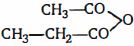
The $IUPAC$ name of  (figure) is
Consider a $70 \%$ efficient hydrogen-oxygen fuel cell working under standard conditions at 1 bar and $298 K$. Its cell reaction is

$H _2( g )+\frac{1}{2} O _2( g ) \rightarrow H _2 O (\ell)$

The work derived from the cell on the consumption of $1.0 \times 10^{-3} mol$ of $H _2( g )$ is used to compress $1.00 mol$ of a monoatomic ideal gas in a thermally insulted container. What is the change in the temperature (in $K$ ) of the ideal gas ?

The standard reduction potentials for the two half-cells are given below.

$\left. O _2( g )+4 H ^{+} \text {(aq. }\right)+4 e ^{-} \rightarrow 2 H _2 O (\ell), E ^{\circ}=1.23 V,$

$\left.2 H ^{+} \text {(aq. }\right)+2 e ^{-} \rightarrow H _2( g ), E ^{\circ}=0.00 V.$

Use $F =96500 C mol ^{-1}, R =8.314 J mol ^{-1} K ^{-1}$

Match list $-I$ with list $-II$ and then select the correct answer from the codes given below that list

                                  List $-I$

$(A){\mkern 1mu} {\mkern 1mu} {\mkern 1mu} {C_6}{H_6} + CO + HCl\,\xrightarrow{{AlC{l_3}}}\,{C_6}{H_5}CHO$

$(B){\mkern 1mu} {\mkern 1mu} {\mkern 1mu} {C_6}{H_5} + C{H_3}$ $\xrightarrow{{Cr{O_2}C{l_2}}}\,{C_6}{H_5}CHO$

$(C){\mkern 1mu} {\mkern 1mu} {\mkern 1mu} {C_6}{H_5}C{H_2}Br\, + \,C{H_3}Br$ $\xrightarrow{{Na/ether}}\,{C_6}{H_5}C{H_2}C{H_3}$

$(D){\mkern 1mu} {\mkern 1mu} {\mkern 1mu} {C_6}{H_6}\, + \,{(C{H_3})_2}C = C{H_2}$ $\xrightarrow{{{H_2}S{O_4}}}\,{C_6}{H_5}C{(C{H_3})_3}$

                                 List $-II$
$(a)$   Friedel-Crafts reaction
$(b)$   Wurtz-Fitting reaction
$(c)$   Gattermann-Koch Aldehyde synthesis
$(d)$   Etard’s reaction

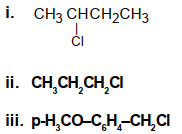
The increasing order of the reactivity of the following halides for the $S_N 1$ reaction is
Image
The shape of $s$-orbital is
Low oxidation state of metals in their complexes are common when ligands.
The molar conductances of $NaCl,\,HCl$ and $C{H_3}COONa$ at infinite dilution are $126.45,\,426.16 $ and $91\,oh{m^{ - 1}}\,c{m^2}\,mo{l^{ - 1}}$ respectively. The molar conductance of $C{H_3}COOH$ at infinite dilution is .............. ${\Omega ^{ - 1}}{\rm{c}}{{\rm{m}}^2}{\rm{mo}}{{\rm{l}}^{ - 1}}$