Question
Assertion  :   Current is passed through a metallic wire, heating it red. When cold water is poured on half of its portion, then rest of the half portion become more hot.  
Reason    : Resistances decreases due to decrease in temperature and so current through wire increases.(a) If both assertion and reason are true and the reason is the correct explanation of the assertion.(b) If both assertion and reason are true but reason is not the correct explanation of the assertion.(c) If assertion is true but reason is false.(d) If the assertion and reason both are false.


Answer

(a) If both assertion and reason are true and the reason is the correct explanation of the assertion.

Need a full question paper?

Generate a complete, print-ready paper with questions like this in minutes — across 16+ boards, with answer keys.

Start Generating Free

Similar questions

A wire of length $L$ metre carrying a current of $I$ ampere is bent in the form of a circle. Its magnitude of magnetic moment will be
If in a nuclear fission, piece of uranium of mass $0.5 g$ is lost, the energy obtained in $\text{kWh}$ is
A particle of mass 'm' and charge 'q' enters in an uniform magnetic field B perpendicularly. The radius of its path will be :
Name a device which is commonly used to convert an electric signal into a visual signal:
A positively charged particle moving due east enters a region of uniform magnetic field directed vertically upwards. The particle will(a) Get deflected vertically upwards(b) Move in a circular orbit with its speed increased(c) Move in a circular orbit with its speed unchanged(d) Continue to move due east


A circular coil $'A\ ’$ has a radius $R$ and the current flowing through it is $I.$ Another circular coil $'B\ ’$ has a radius $2R$ and if $2I$ is the current flowing through it, then the magnetic fields at the centre of the circular coil are in the ratio of (i.e. $B _{ A }$ to $B _{ B }$ )
A particle moves on the $X-$axis according to the equation $\text{x = A + B}\sin\omega\text{t}.$ The motion is simple harmonic with amplitude:
A current $I$ is passed for a time $t$ through a number of voltameters. If $m$ is the mass of a substance deposited on an electrode and $z$ is its electrochemical equivalent, then
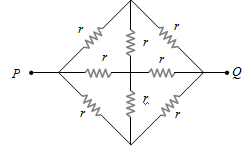
The equivalent resistance between the points $P$ and $Q$ in the network given here is equal to $($given $r = \frac{3}{2} \Omega)$

The lamp whose working is based on a discharge tube is ________: