MCQ
$Assertion$ : Frictional forces are conservative forces.
$Reason$ : Potential energy can be associated with frictional forces.
  • A
    If both Assertion and Reason are correct and the Reason is a correct explanation of the Assertion.
  • B
    If both Assertion and Reason are correct but Reason is not a correct explanation of the Assertion.
  • C
    If the Assertion is correct but Reason is incorrect.
  • If both the Assertion and Reason are incorrect.
Answer

Correct option: D.
If both the Assertion and Reason are incorrect.
d
Frictional force is non-conservative as work done against frictional force can not be stored as potential energy.

Need a full question paper?

Generate a complete, print-ready paper with questions like this in minutes — across 16+ boards, with answer keys.

Start Generating Free

Similar questions

Suppose a container ia evacuated to leave just one molecule of a gas in it. Let Va and vrms represent the average speed and the rms speed of the gas.
A particle is moving in a circle of radius $r$ under the action of a force $F\, = \alpha r^2$ which is directed towards centre of the circle. Total mechanical energy (kinetic energy + potential energy) of the particle is (take potential energy $= 0$ for $r\, = 0$)
Water $\left(\rho=1000 \,kg / m ^3\right)$ and kerosene $\left(\sigma=800 \,kg / m ^3\right)$ are filled in two identical cylindrical vessels. Both vessels have small holes at their bottom. The speed of the water and kerosene coming out of their holes are $v_1$ and $v_2$ respectively. Select the correct alternative
A diatomic ideal gas is used in a Carnot engine as the working substance. If during the adiabatic expansion part of the cycle the volume of the gas increases from $V$ to $32\ V$, the efficiency of the engine is
A tuning fork produces 4 beats $/ sec$. with 50 cm and 40 cm of a stretched wire, of a sonometer. The frequency of fork is:
A sample of an ideal gas undergoes an isothermal expansion. If $d Q, d U$ and $d W$ represent the amount of heat supplied, the change in internal energy and the work done respectively, then
One gm mol of a diatomic gas $(\gamma = 1.4)$ is compressed adiabatically so that its temperature rises from ${27^o}C$ to ${127^o}C$. The work done will be
A spring executes $SHM$ with mass of $10\,kg$ attached to it. The force constant of spring is $10\,N/m$.If at any instant its velocity is $40\,cm/sec$, the displacement will be .... $m$ (where amplitude is $0.5\,m$)
A string fixed at both ends vibrates in three loops. The wave length is $10\, cm$ . The length of string is .... $cm$
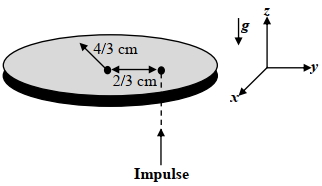
A thin circular coin of mass $5 \mathrm{gm}$ and radius $4 / 3 \mathrm{~cm}$ is initially in a horizontal $x y$-plane. The coin is tossed vertically up ( $+z$ direction) by applying an impulse of $\sqrt{\frac{\pi}{2}} \times 10^{-2} \mathrm{~N}-\mathrm{s}$ at a distance $2 / 3 \mathrm{~cm}$ from its center. The coin spins about its diameter and moves along the $+z$ direction. By the time the coin reaches back to its initial position, it completes $n$ rotations. The value of $n$ is. . . . . [Given: The acceleration due to gravity $\mathrm{g}=10 \mathrm{~ms}^{-2}$ ]