MCQ
$Assertion :$ In adiabatic compression, the internal energy and temperature of the system get decreased.
$Reason :$ The adiabatic compression is a slow process.
  • A
    If both Assertion and Reason are correct and the Reason is a correct explanation of the Assertion.
  • B
    If both Assertion and Reason are correct but Reason is not a correct explanation of the Assertion.
  • C
    If the Assertion is correct but Reason is incorrect.
  • If both the Assertion and Reason are incorrect.
Answer

Correct option: D.
If both the Assertion and Reason are incorrect.
d
Adiabatic compression is a fast process. There is rise in temperature and also increase in internal energy. So, both are false.

Need a full question paper?

Generate a complete, print-ready paper with questions like this in minutes — across 16+ boards, with answer keys.

Start Generating Free

Similar questions

The measured value of the length of a simple pendulum is $20 \mathrm{~cm}$ with $2 \mathrm{~mm}$ accuracy. The time for $50$ oscillations was measured to be $40$ seconds with $1$ second resolution. From these measurements, the accuracy in the measurement of acceleration due to gravity is $\mathrm{N} \%$. The value of $\mathrm{N}$ is:
A solid cylinder and a solid sphere of same mass and radius roll without slipping on a rough inclined plane. The force of friction is ..........
The internal energy of an ideal gas decreases by the same amount as the work done by the system:
  1. The process must be adiabatic.
  2. The process must be isothermal.
  3. The process must be isobaric.
  4. The temperature must decrease.
The displacement at a point due to two waves are $y_1=4 \sin (500 \pi t)$ and $y_2=2 \sin (506 \pi t)$. The result due to their superposition will be
The $SI$ unit of mechanical equivalent of heat is
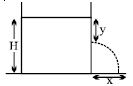
Acylindrical vessel is filled with a liquid up to height H.A small hole is made in the vessel at a distance $y$ below the liquid surface as shown in figure. The liquid emerging from the hole strike the ground at distance $x$
Which of the following pairs of quantities have the same dimensions?
A body under the action of a force $\vec F = 6\hat i - 8\hat j\,N$ acquires an acceleration of $5\, ms^{-2}$. The mass of the body is 
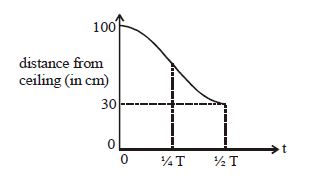
A spring hangs vertically from the ceiling and a mass is attached to its free end. When the mass is pulled down and released, it oscillates vertically with simple harmonic motion of period $T$ . The variation with time $t$ of its distance from the ceiling is as shown. Which statement gives a correct deduction from this graph?
A car is moving in a spiral starting from the origin with uniform angular velocity. What can be said about the instantaneous velocity?